
Forged Bars / FRB
Forged Round Bars
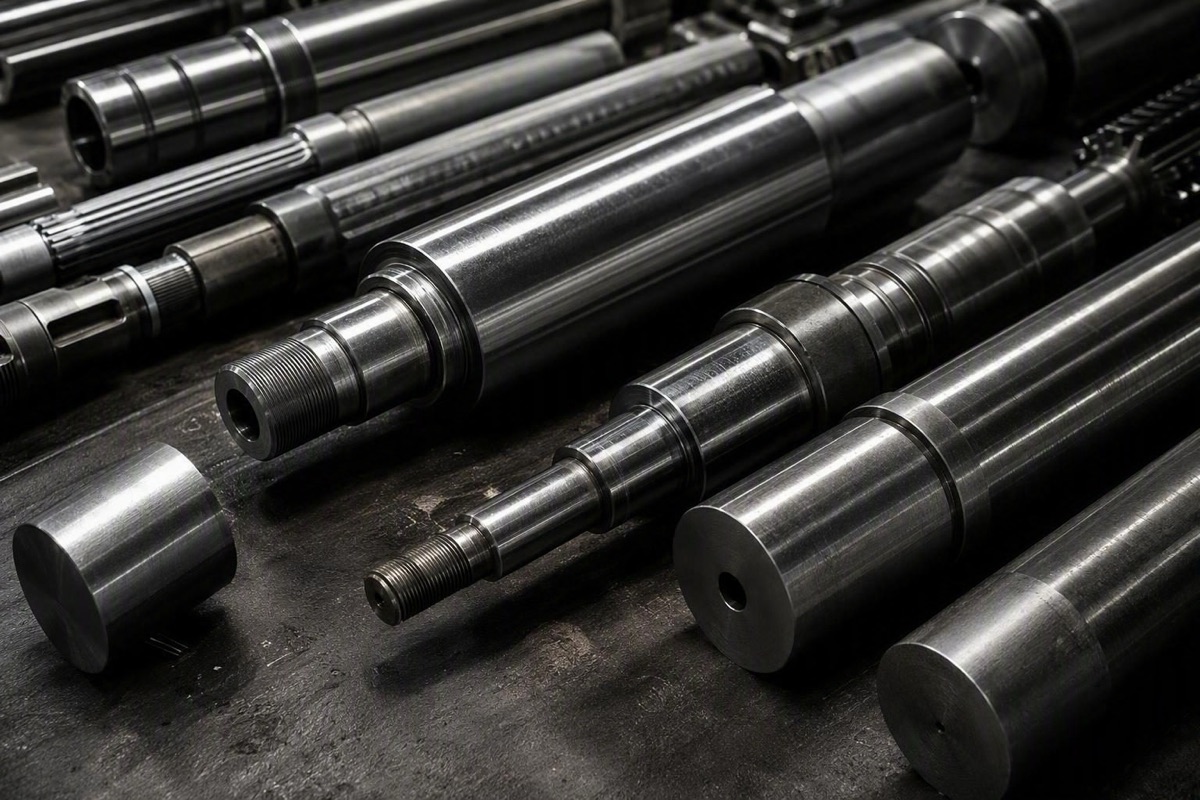
Forged round steel bars in 200-1000mm diameter range, compliant with UNE 36-514-84 standard. High mechanical strength products for power generation, mining, and heavy machinery applications.
Technical Specifications
Key Features
- Dense internal structure from forging pressure
- High mechanical strength and homogeneity
- Large diameter capability up to 1000mm
- Full ultrasonic testing (EN 10308)
- Heat treatment options (Q+T, Normalization, Annealing)
- Custom length cutting (2.5 - 7 meters)
- Surface finish: black, turned, ground
- Certified material (EN 10204 3.1/3.2)
Applications
- Power plant shafts and rotors
- Offshore and subsea equipment
- Mining crusher shafts
- Heavy machinery axles
- Turbine discs and generator shafts
- Cement plant equipment
- Shipbuilding shafts
- Press and rolling mill cylinders
Dimension Table
| Dimension (mm) | Length (m) | Weight (kg/m) | Tolerance (mm) | Standard |
|---|---|---|---|---|
| Ø200 | 2.5 - 6.0 | 246.6 | +5/-0 | UNE 36-514-84 |
| Ø250 | 2.5 - 6.0 | 385.4 | +5/-0 | UNE 36-514-84 |
| Ø300 | 2.5 - 6.0 | 554.9 | +6/-0 | UNE 36-514-84 |
| Ø350 | 2.5 - 7.0 | 755.0 | +6/-0 | UNE 36-514-84 |
| Ø400 | 2.5 - 7.0 | 986.0 | +7/-0 | UNE 36-514-84 |
| Ø500 | 2.5 - 7.0 | 1541.0 | +8/-0 | UNE 36-514-84 |
| Ø600 | 3.0 - 7.0 | 2219.0 | +9/-0 | UNE 36-514-84 |
| Ø700 | 3.0 - 6.0 | 3020.0 | +10/-0 | UNE 36-514-84 |
| Ø800 | 3.0 - 6.0 | 3944.0 | +11/-0 | UNE 36-514-84 |
| Ø900 | 3.0 - 5.0 | 4993.0 | +12/-0 | UNE 36-514-84 |
| Ø1000 | 3.0 - 5.0 | 6165.0 | +13/-0 | UNE 36-514-84 |
Technical Notes
- 01All products undergo ultrasonic examination per EN 10308.
- 02Heat treatment condition is determined by customer specification.
- 03Surface quality: Ra 3.2 (turned), Ra 0.8 (ground) options available.
- 04Material certificates issued as EN 10204 3.1 or 3.2.
- 05Minimum order quantity applies for custom diameter and length requests.
Other Types
What is a forged bar?
A forged bar is produced by pressing or hammering steel above its recrystallization temperature (~1100–1250°C). Forging closes internal voids and casting porosity, aligns the grain flow with the part geometry, and gives higher toughness, fatigue strength and internal soundness than rolled product. It is preferred for large-diameter shafts, gear blanks and critical machine parts.
Open-die forging, reduction ratio and quality assurance
In open-die forging, the material is progressively drawn out and rotated under a press; a reduction ratio of at least 3:1 is typically specified — it breaks up the ingot structure and homogenizes mechanical properties. Forgings are then normalized or quenched and tempered. Internal soundness is verified by ultrasonic testing (EN 10228 / SEP 1921). Q&T grades such as 42CrMo4, C45 and 34CrNiMo6 are the most common forged qualities; diameters beyond rolling capacity (Ø200 mm+) can only be produced by forging.
Frequently Asked Questions
Forged bar vs rolled bar — what is the difference?+
Forging closes internal porosity and aligns grain flow, giving higher toughness and fatigue strength in the same grade. Rolling is faster and cheaper; forging is chosen for large diameters and critical parts.
Why does the reduction ratio matter?+
A ratio of at least 3:1 breaks up ingot segregation and voids, guaranteeing a homogeneous, sound core. Critical specifications state it explicitly.
Which grades are supplied as forged bar?+
Most commonly Q&T steels such as 42CrMo4, C45, 34CrNiMo6 and 36CrNiMo4, plus tool steels and large-section carbon steels.
How are forged bars tested?+
Ultrasonic testing (EN 10228/SEP 1921) verifies internal soundness; chemistry and mechanical tests are reported in the EN 10204 3.1 certificate.
Related Blog Posts
Technical articles, guides and industry analyses
C45 vs 42CrMo4 Steel: Carbon or Alloy — Which to Choose?
We compare C45 (1045) carbon steel with 42CrMo4 (4140) chrome-moly quenched & tempered steel by hardenability, strength, welding and cost — which to choose and when?
Quenched and Tempered Steels: EN 10083 Grades, Values and How to Choose
Quenched and tempered (Q&T) steel is the class that delivers strength and toughness together. We put the six main EN 10083 grades — C45, 25CrMo4, 42CrMo4, 39NiCrMo3, 34CrNiMo6, 51CrV4 — into one table with chemistry, section-dependent values and selection criteria.