
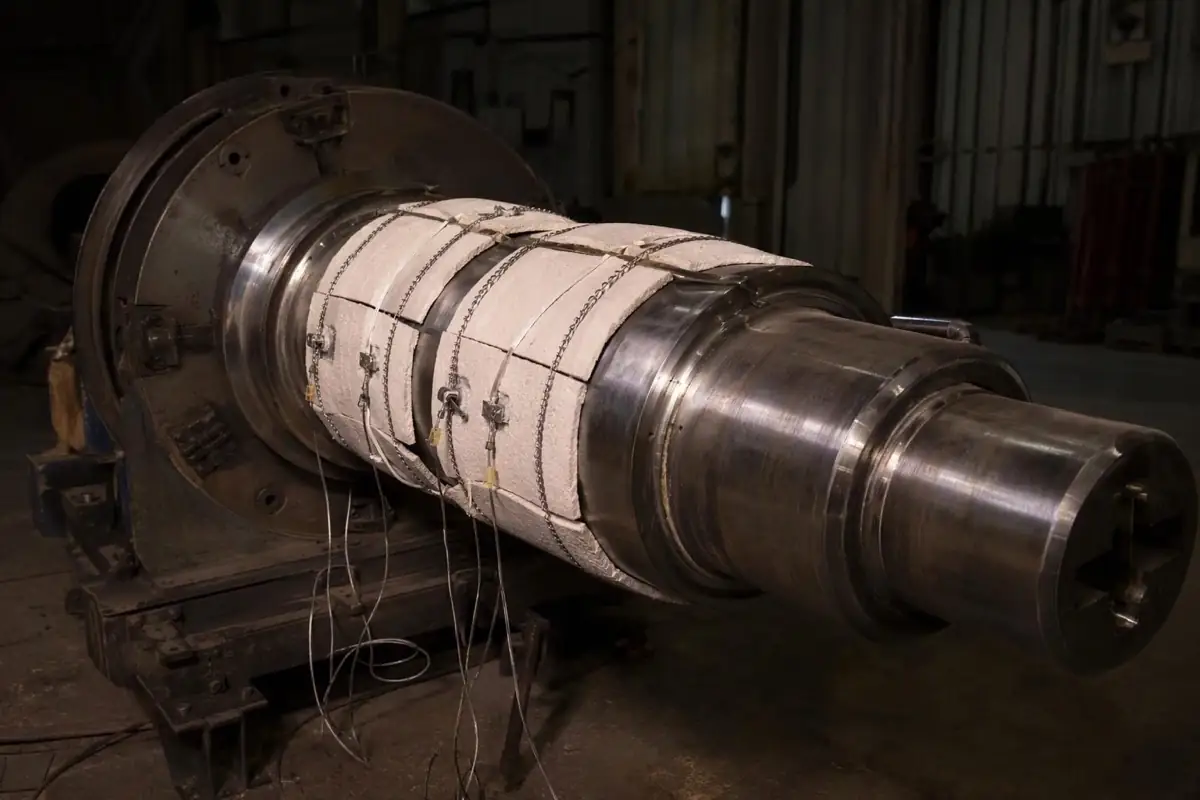
Welding 42CrMo4: Preheat, Interpass and PWHT for Q&T Steels
42CrMo4 and other quenched and tempered steels can be welded, but only under conditions: preheat, low-hydrogen consumables, controlled interpass temperature and post-weld heat treatment. The rule most often missed: on a quenched and tempered part, PWHT must not exceed the tempering temperature of the material. Datasheet values, the EN 1011-2 calculation and a work-order checklist.
📋 42CrMo4 Datasheet → · Tool: Carbon Equivalent Calculator · Related article: CEV, CET and Pcm
Short Answer
42CrMo4 can be welded, but only with a controlled procedure. The guide values in our datasheet are a 200–300 °C preheat, low-hydrogen electrodes and post-weld stress relieving (about 550–650 °C). Two rules must be added. First, the interpass temperature must not drop below the preheat. Second, on a quenched and tempered (+QT) part, post-weld heat treatment (PWHT) must not exceed the temperature at which the material was tempered; otherwise the part is re-tempered and loses strength. The binding values are those written in the welding procedure qualified to EN ISO 15614-1 (WPS/WPQR).
Why Are Q&T Steels Difficult to Weld?
The property that makes quenched and tempered steels valuable is exactly the one that causes trouble in welding: hardenability. During welding, the heat-affected zone (HAZ) is heated into the austenite range and cools quickly. In 42CrMo4, with 0.38–0.45% carbon plus chromium and molybdenum, this cooling forms hard, brittle martensite in the HAZ. When diffusible hydrogen in the weld metal and restraint stresses in the joint meet this hard structure, cold (hydrogen) cracking occurs. These cracks often appear hours after welding.
Preheat does two jobs: it lowers the cooling rate, limiting the formation of the hard structure, and it gives hydrogen time to escape from the joint. We showed how the carbon equivalent turns this risk into a number in our article on CEV, CET and Pcm, where we calculated a CEV of about 0.80 for 42CrMo4.
The Temperature Window of Q&T Steels
The table below puts side by side the welding and heat-treatment values published in our grade datasheets. The column to watch is the one on the right: the upper limit for post-weld heat treatment is set by the tempering temperature of the material.
| Grade | Preheat recommended in datasheet | +QT tempering range (datasheet) | Weldability |
|---|---|---|---|
| 25CrMo4 | 150–250 °C for thick sections; thin walls TIG-welded without preheat | 540–680 °C | Good |
| C45 | 150–250 °C for thick sections | 550–660 °C | Fair |
| 41Cr4 | Per qualified procedure | 540–680 °C | Limited |
| 42CrMo4 | 200–300 °C | 540–680 °C | Conditional |
| 34CrNiMo6 | 250–350 °C | 540–660 °C | Difficult |
| 50CrMo4 | Not recommended; if unavoidable, per procedure | 540–680 °C | Not recommended |
Source: Aktif Çelik grade datasheets (guide values). The tempering range is the band used for quenching and tempering; the actual tempering temperature of a given lot can be anywhere within it.
The table exposes an important conflict. The 550–650 °C stress-relief band given for 42CrMo4 overlaps the tempering band (540–680 °C). If the material was tempered at 560 °C, a PWHT at 650 °C tempers it a second time at a higher temperature; yield and tensile strength can fall below the +QT values. On a Q&T part, the PWHT temperature is therefore chosen below the actual tempering temperature of that lot, with a safety margin defined in the WPS. If the tempering temperature is not on the certificate, ask the supplier for it.
Can Preheat Be Calculated? The Limit of EN 1011-2
EN 1011-2 gives two methods for determining preheat. Method B combines the CET carbon equivalent, plate thickness (d), diffusible hydrogen (HD) and heat input (Q):
Tp = 697·CET + 160·tanh(d/35) + 62·HD^0.35 + (53·CET − 32)·Q − 328
The formula has a narrow validity range: CET 0.2–0.5; d 10–90 mm; HD 1–20 ml/100 g; Q 0.5–4.0 kJ/mm; and carbon must lie between 0.05 and 0.32%. The carbon content of 42CrMo4, C45 and 34CrNiMo6 is above this limit, so Method B cannot be applied to them. For these steels, preheat is set by the datasheet recommendation and the welding procedure test.
Among Q&T steels, the grade that falls inside the formula's range is 25CrMo4. We calculated the table below for this grade.
| Thickness d | HD 5, Q 1.0 kJ/mm | HD 5, Q 2.0 kJ/mm | HD 10, Q 1.0 kJ/mm | HD 10, Q 2.0 kJ/mm |
|---|---|---|---|---|
| 20 mm | 135 °C | 125 °C | 165 °C | 155 °C |
| 40 mm | 183 °C | 173 °C | 213 °C | 202 °C |
| 60 mm | 203 °C | 192 °C | 232 °C | 222 °C |
Basis: EN 1011-2 Method B; mid-points of the EN 10083-3 ranges for 25CrMo4 (C 0.255 · Mn 0.75 · Cr 1.05 · Mo 0.225; Cu and Ni zero), giving CET = 0.405. Values rounded to the nearest degree. The actual preheat is calculated from the cast analysis on the certificate.
Three practical conclusions follow. Preheat rises with thickness, but the increase slows in heavy sections. Lowering hydrogen from 10 to 5 ml/100 g cuts the preheat by about 30 °C, which puts a number on the value of low-hydrogen consumables. Raising the heat input also lowers the preheat, but the effect is smaller. The 183 °C found for 40 mm agrees with the 150–250 °C recommendation for thick sections in our datasheet.
Hydrogen, Consumables and Interpass Temperature
- Consumables: Use basic, low-hydrogen electrodes or wire. The H5 symbol in EN ISO 2560-A means at most 5 ml/100 g of diffusible hydrogen in the weld metal. Electrodes must be baked according to the manufacturer's instructions.
- Strength matching: The strength of the weld metal is chosen by design. When 42CrMo4 is joined to a different steel such as S355, the side with the higher carbon equivalent (42CrMo4) sets the preheat; the filler is often matched to the lower-strength side.
- Interpass: The minimum interpass temperature is the preheat temperature. The maximum is written separately in the WPS. Temperatures are measured according to EN ISO 13916.
- After welding: Do not let the part cool freely. Either hold it at preheat temperature until heat treatment, or insulate it for slow cooling. Because of the risk of delayed cracking, non-destructive testing is done after the waiting time set in the specification.
Repair Welding: Before You Touch a Q&T Shaft
There are three ways to repair a broken or worn 42CrMo4 shaft:
- PWHT below the tempering temperature: The most common route. HAZ hardness is reduced while the +QT strength of the material is preserved.
- Complete re-hardening and tempering of the part: After welding, the part is quenched and tempered again. Distortion and finishing allowance must be considered.
- Temper bead technique: Beads are placed so that each one tempers the HAZ of the previous one. It is used where PWHT is not possible and always requires a qualified procedure.
Austenitic or nickel-based fillers are preferred for some repairs because the weld metal can hold more hydrogen. However, they do not prevent hardening in the HAZ of the base metal, and they do not remove the need for preheat.
Which One Should You Choose?
- Weld-intensive structures: not a Q&T steel, but a structural steel such as S355J2.
- A part that will be welded and needs strength: among Q&T steels, 25CrMo4, thanks to its lower carbon.
- If 42CrMo4 is mandatory: welding in the +A (soft annealed) condition and quenching and tempering the part afterwards is usually safer than welding a +QT part.
- Large Ni-Cr-Mo shafts: for grades such as 34CrNiMo6, welding should be the exception; for grade selection by section size, see our 42CrMo4, 34CrNiMo6 and 30CrNiMo8 article.
What to Write in the Work Order and Purchase Order
- Grade, standard and delivery condition: e.g.
42CrMo4+QT, EN 10083-3 - Full cast analysis on the EN 10204 3.1 certificate (C, Mn, Cr, Mo, Ni, Cu, V); the carbon equivalent is calculated from it
- For +QT material, the tempering temperature
- Welding procedure: WPS and WPQR to EN ISO 15614-1
- Preheat, interpass (minimum / maximum), PWHT temperature and holding time
- Post-weld hardness measurement and the scope of non-destructive testing
You can check a certificate analysis against the standard ranges with the Chemical Composition tool and the carbon equivalent with the Carbon Equivalent tool. The Hardness Converter translates hardness readings between scales.
Frequently Asked Questions
Which electrode is used to weld 42CrMo4?
Basic, low-hydrogen (H5) electrodes or wire. The strength class of the weld metal is chosen by design; when joining to other steels, a filler matched to the lower-strength side is often preferred.
What happens if there is no preheat?
Hard martensite forms in the HAZ and, combined with hydrogen, raises the risk of cold cracking. Because these cracks can appear hours after welding, they may not be visible at the first visual check.
At what temperature should a Q&T shaft be stress relieved after welding?
Below the actual tempering temperature of the material, with a safety margin defined in the WPS. The 550–650 °C band in the datasheet is a general guide; on a +QT part, the upper limit is set by the material's tempering temperature.
Can 42CrMo4 be welded to S355?
Yes, as a dissimilar weld. Preheat and interpass are set for the 42CrMo4 side, and the procedure is qualified separately for this material combination.
Supply from Aktif Çelik
We supply 42CrMo4, 34CrNiMo6, 25CrMo4 and other Q&T steels as hot-rolled, forged and bright bars with an EN 10204 3.1 inspection certificate that includes the full cast analysis. If you need material for a welded application, state the delivery condition (+A or +QT) and the information you want on the certificate (for example, the tempering temperature) in your request; we will confirm the requirements with the producers in our supply network. Third-party inspection by SGS, Bureau Veritas or TÜV can be arranged on request. Quotations are sent within 24 hours.
🔗 See also: Quality & Certificates · Quenched and Tempered Steels Guide
Detailed Technical Info & Quotation
Contact our expert team for detailed technical documents, application recommendations, and custom dimension quotes on this topic.