
Jominy Test and Hardenability: When to Order +H, +HH or +HL
Hardenability is not how hard a steel gets, but how deep into the section it can carry that hardness. We explain how the Jominy end quench test is done, how to read the curve, and in which parts and processes +H, +HH and +HL grades are really needed.
📋 16MnCr5 Datasheet → · 42CrMo4 Datasheet → · Related article: Quenched and Tempered Steels Guide
Short Answer
Hardenability is not the maximum hardness a steel reaches on quenching, but how deep into the section it can carry that hardness. The standard way to measure it is the Jominy end quench test (EN ISO 642; ASTM A255 in the US). An austenitized specimen is cooled with water at one end only, and hardness is then measured as a function of distance from the quenched end. The resulting curve shows in a single graph how hard the steel gets at different cooling rates.
The standards for alloy quenched-and-tempered and case-hardening steels (EN 10083-3 and EN 10084; now EN ISO 683-2 and EN ISO 683-3) define a band with lower and upper limits for this curve in the +H grades. +HH guarantees the upper part of the band (raised lower limit) and +HL the lower part (lowered upper limit). These codes are not needed on every order; their real value shows in series parts that the buyer heat treats.
Hardness and Hardenability Are Not the Same
What separates the two concepts is which element controls what:
- Maximum hardness is mainly controlled by carbon. Two steels with similar carbon reach similar surface hardness when a thin section is quenched. That is why our datasheets give more than 55 HRC at the surface for quenched C45 and 54–59 HRC for as-quenched 42CrMo4.
- Carrying that hardness into depth is controlled by alloying. Chromium, molybdenum, nickel, manganese and small amounts of boron slow down the transformation, allowing the core of the section to turn into martensite as well.
The clearest proof is in the standards' own tables: in EN 10083 the +QT values for C45 stop at 100 mm, while the tables for 42CrMo4 and 34CrNiMo6 continue to 250 mm. We cover this in our quenched and tempered steels guide, and grade selection by section size in our 42CrMo4, 34CrNiMo6 and 30CrNiMo8 article.
How Is the Jominy Test Done?
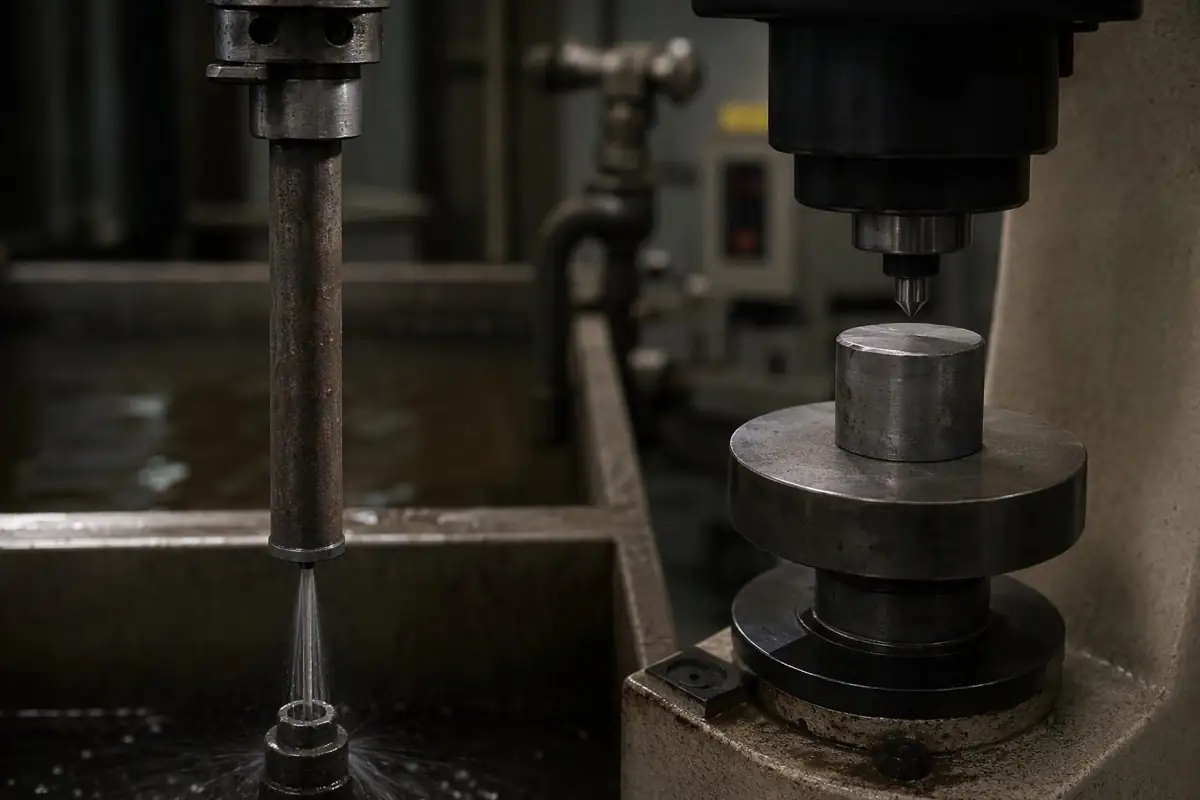
The value of the test is that a single specimen covers a wide range of cooling rates. The quenched end cools very fast, the other end much more slowly. The main parameters are:
| Parameter | Value in EN ISO 642 |
|---|---|
| Specimen | Ø25 mm × 100 mm cylinder |
| Austenitizing | Temperature given for the grade in the product standard |
| Cooling water temperature | 20 ± 5 °C |
| Internal diameter of water pipe | 12.5 mm |
| Free height of water jet without specimen | 65 ± 10 mm |
| Distance from pipe end to specimen bottom face | 12.5 mm |
| Hardness measuring surface | Longitudinal flats ground to a depth of 0.4–0.5 mm |
| Result | HRC curve versus distance (mm) from the quenched end |
Source: EN ISO 642. Details such as the transfer time from furnace to fixture and the quenching time are defined in the standard.
The specimen is held vertically, and only its bottom face touches the water. Cooling is therefore one-directional, and each distance corresponds to a specific cooling rate. The ground flat removes the decarburized surface layer so that the measurement represents the actual material.
How to Read the Curve
Three things are checked when reading a Jominy curve:
- The value at the end: the reading closest to the quenched end is close to the maximum hardness the steel can reach and is mainly a function of carbon.
- How fast it drops: the faster the curve falls away from the end, the lower the hardenability. In non-alloy steels the curve drops markedly over a short distance; in Cr-Mo and Ni-Cr-Mo steels it stays flatter.
- The width of the band: for +H grades the standard gives minimum and maximum hardness at specified distances. The upper curve represents heats with compositions near the upper limits of the ranges; the lower curve, heats near the lower limits.
Which point of a bar of a given diameter, quenched in a given medium, corresponds to a Jominy distance is estimated with conversion diagrams from the literature. This estimate is a rough design guide; for critical heavy sections, mechanical values are taken from the part itself or from a representative test piece. ASTM A255 also contains a method for estimating hardenability by calculation from the composition; the calculation does not replace the test.
+H, +HH, +HL: Where Are They Really Needed?
The table below summarizes when a hardenability band adds value to an order. It is our assessment; the final decision depends on the part drawing and the heat-treatment process.
| Part and process | Recommended order | Why |
|---|---|---|
| Carburized series gears and shafts (16MnCr5, 20MnCr5, 18CrNiMo7-6) | +HH or +HL (narrowed band) | Core hardness and distortion vary less from heat to heat; the heat-treatment setup stays stable |
| Shafts to be quenched and tempered as parts (42CrMo4, 34CrNiMo6) | +H; +HH if the section is close to the grade's limit | Ensures, heat by heat, that the required hardness is reached at the core |
| Quenched and tempered (+QT) bar | +QT mechanical values instead of Jominy | Heat treatment is done by the supplier; acceptance is by tensile test and hardness |
| Shafts to be induction hardened (C45, 41Cr4, 42CrMo4) | +H usually not needed; specify carbon range and prior structure (+QT or +N) | The hardened layer is thin; surface hardness is set by carbon, depth by the induction process |
| Very large forged shafts (30CrNiMo8, 34CrNiMo6) | Correct grade selection + mechanical tests on the part | A Ø25 mm Jominy specimen does not fully represent the cooling of a heavy section |
The main message of the table: the +H code is valuable where the buyer does the heat treatment. If the material arrives already quenched and tempered, what counts is not hardenability but the mechanical values measured on the bar itself. For the full list of delivery condition codes, see our delivery condition codes article; for selecting case-hardening steels, our case-hardening steels guide.
What Spoils Hardenability?
The main reasons why two heats of the same grade behave differently:
- Composition drifting within the range: if carbon, chromium or manganese is near the low end of its range, the curve approaches the lower limit. This is why narrowed bands are ordered.
- Grain size: coarse-grained steel hardens deeper but loses toughness. That is why a fine-grain requirement matters for case-hardening steels.
- Boron effect: small amounts of boron raise hardenability markedly; the effect depends on how boron interacts with nitrogen and titanium. If a boron grade is used, state it clearly in the order.
You can compare a certificate analysis with the standard ranges using the Chemical Composition tool and convert measured hardness between scales with the Hardness Converter.
Which One Should You Choose?
- You do the heat treatment yourself, in series production: +H; if distortion and core-hardness consistency are critical, +HH or +HL.
- You buy the material quenched and tempered: +QT with mechanical values by section; do not add a Jominy requirement.
- The section is close to the grade's limit: first consider moving one alloy level up; +HH does not replace that, it only adds margin.
- Induction and flame hardening: the carbon range and the prior heat-treatment condition matter more than the hardenability band.
What to Write in the Specification
- Grade and delivery condition: e.g.
16MnCr5+HH, EN 10084or42CrMo4+H, EN 10083-3 - If needed, limits agreed with the customer for specific Jominy points
- Jominy results reported per heat on the EN 10204 3.1 inspection certificate
- Grain size requirement (especially for case-hardening steels)
- Product form, size and tolerance
- Third-party inspection by SGS, Bureau Veritas or TÜV on request
Frequently Asked Questions
What is the Jominy test?
It is the end quench test that measures the hardenability of steel. A Ø25 mm × 100 mm specimen is austenitized, only one end is cooled with a water jet, and hardness is measured as a function of distance from the quenched end. The method is defined in EN ISO 642.
What is the difference between +HH and +HL?
Both narrow the +H band. In +HH the lower limit is raised, so the steel sits in the upper part of the band. In +HL the upper limit is lowered, so the steel sits in the lower part. The choice depends on whether the part needs higher core hardness or lower distortion and higher toughness.
Does hardenability increase with carbon?
Carbon sets the maximum attainable hardness; carrying that hardness into depth is mainly provided by alloying elements such as chromium, molybdenum, nickel, manganese and boron.
Does a Jominy result directly give the core hardness of a shaft?
No. Which point of a bar of a given diameter corresponds to a Jominy distance is estimated with conversion diagrams. For critical heavy sections, core values are measured on the part itself or on a representative test piece.
Supply from Aktif Çelik
We supply case-hardening steels and alloy quenched-and-tempered steels as hot-rolled and forged bars with an EN 10204 3.1 inspection certificate. State requirements such as +H, +HH or +HL, specific Jominy points or grain size in your request; we will confirm availability with the producers in our supply network. Quotations are sent within 24 hours; lead time and minimum quantity vary by product and are stated in the quote.
🔗 See also: Quality & Certificates · Steel Equivalence Tables
Detailed Technical Info & Quotation
Contact our expert team for detailed technical documents, application recommendations, and custom dimension quotes on this topic.