
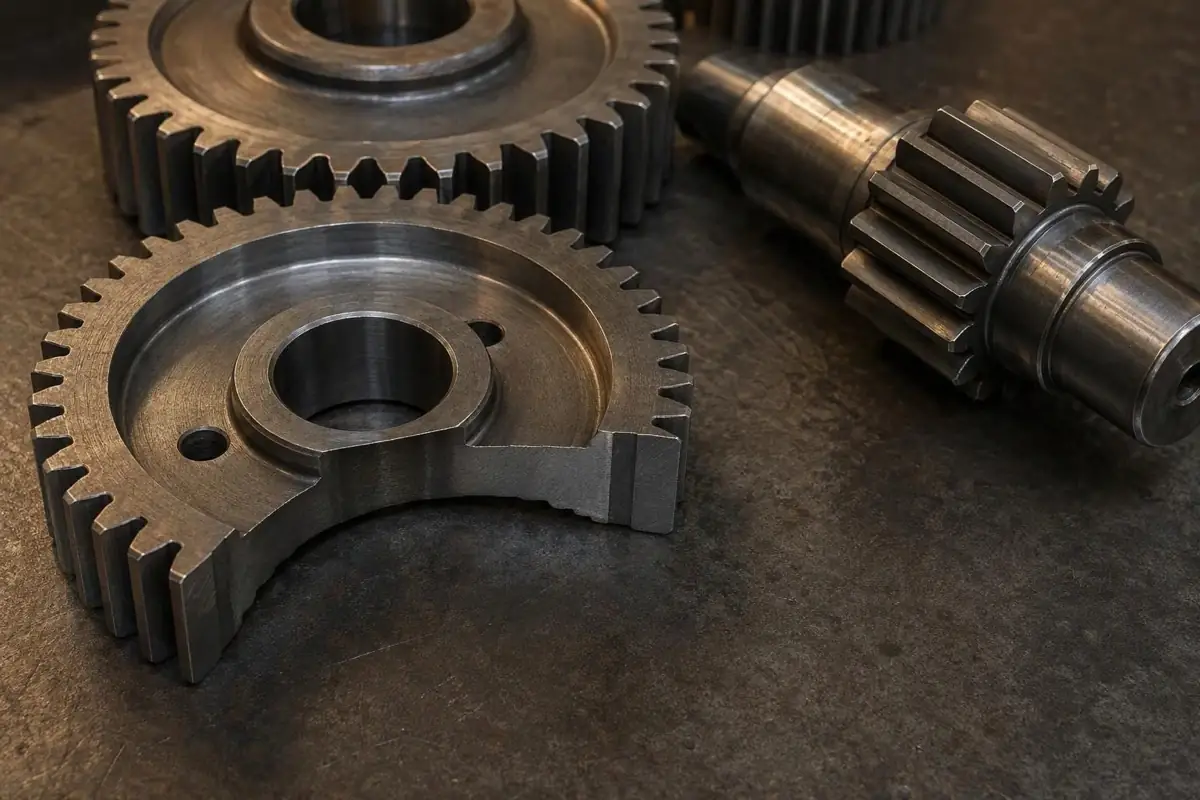
Case Hardening Steels Guide: How to Choose 16MnCr5, 20MnCr5, 8620 and 18CrNiMo7-6
Case hardening steels are low-carbon steels whose surface is enriched with carbon and then hardened: a hard, wear-resistant case over a tough core. We put the leading EN 10084 grades — C15E, 16MnCr5, 20MnCr5, 20NiCrMo2-2, 18CrNiMo7-6 — into one guide with chemistry, case-depth logic, delivery conditions and selection criteria.
📋 Datasheets for the grades in this guide: 16MnCr5 → · 20MnCr5 → · 8620 (20NiCrMo2-2) → · C15 →
What Is Case Hardening Steel?
Case hardening steel (German Einsatzstahl, also called carburizing steel) is a low-carbon steel (roughly 0.10–0.25 % C) whose surface is later enriched with carbon and hardened. The finished part has a hard, wear-resistant surface (typically 58–62 HRC) over a tough core. The European standard for this class is EN 10084.
This article is the twin of our quenched and tempered steels guide. A quenched and tempered steel spreads its strength across the whole section; a case hardening steel puts hardness only where it is needed — at the surface. That is why parts that both wear and take shock loads, such as gear teeth, cams, pins and bearing journals, are made from case hardening steel.
How Does Case Hardening Work?
The process has three steps:
- Carburizing: The part is held in a carbon-releasing medium (usually a gas atmosphere; salt baths and solid media are also used) in the austenite range, typically at 880–980 °C. Carbon diffuses inward and raises the surface carbon to around the eutectoid level, roughly 0.7–0.9 %.
- Quenching: The carbon-rich surface transforms to martensite and hardens. The low-carbon core stays tough, depending on alloy content and section size. Quenching can be done directly from the carburizing temperature or after reheating.
- Low-temperature tempering: Tempering at 150–200 °C relieves quenching stresses while largely preserving surface hardness.
Case depth is set by carburizing time and temperature. Drawings usually specify it as CHD (case hardening depth): the depth below the surface at which hardness falls to 550 HV (ISO 18203). The required depth depends on the load and, for gears, on the module; the designer sets it. Typical values range from a few tenths of a millimetre to about 2 mm.
The Key EN 10084 Grades
EN 10084 lists more than thirty grades. In practice, most orders concentrate on the following:
| Grade | Mat. No. | AISI/SAE ≈ | Alloy system | Core strength | Typical use | Datasheet |
|---|---|---|---|---|---|---|
| C15E | 1.1141 | ≈ 1015 | Unalloyed | Low | Small pins, bushes, lightly loaded parts | C15 |
| 16MnCr5 | 1.7131 | 5115 | Mn-Cr | Medium | Gears, camshafts, transmission parts | 16MnCr5 |
| 20MnCr5 | 1.7147 | 5120 | Mn-Cr | Medium–high | More heavily loaded gears, pinions | 20MnCr5 |
| 20NiCrMo2-2 | 1.6523 | 8620 | Ni-Cr-Mo | Medium–high, tougher | Transmission gears, drive parts | 8620 |
| 17NiCrMo6-4 | 1.6566 | — | Ni-Cr-Mo | High | Gears of medium to large section | — |
| 18CrNiMo7-6 | 1.6587 | — | Cr-Ni-Mo | Very high | Heavy gearbox gears, large pinions | 18CrNiMo7-6 |
"—" means there is no direct AISI equivalent; a close grade can only be chosen by comparing chemistry and hardenability.
Chemical Composition Compared
| Element | C15E | 16MnCr5 | 20MnCr5 | 20NiCrMo2-2 | 18CrNiMo7-6 |
|---|---|---|---|---|---|
| C | 0.12–0.18 | 0.14–0.19 | 0.17–0.22 | 0.17–0.23 | 0.15–0.21 |
| Si | ≤ 0.40 | ≤ 0.40 | ≤ 0.40 | ≤ 0.40 | ≤ 0.40 |
| Mn | 0.30–0.60 | 1.00–1.30 | 1.10–1.40 | 0.65–0.95 | 0.50–0.90 |
| Cr | — | 0.80–1.10 | 1.00–1.30 | 0.35–0.70 | 1.50–1.80 |
| Mo | — | — | — | 0.15–0.25 | 0.25–0.35 |
| Ni | — | — | — | 0.40–0.70 | 1.40–1.70 |
Values are EN 10084 cast analysis ranges (% by mass); P and S limits vary by grade.
An S in the name (for example 16MnCrS5) means sulphur is controlled at 0.020–0.040 % for better machinability; the rest of the grade is unchanged. To compare a mill analysis with these ranges, use our Chemical Composition tool.
What the Alloying Does: Core and Section Size
In case hardening, surface hardness is set mainly by the carbon added to the surface, which is why 16MnCr5 and 18CrNiMo7-6 reach similar surface hardness. The real difference between grades shows in the core. Alloying elements (Mn, Cr, Ni, Mo) raise hardenability so that the core still reaches adequate strength in heavier sections:
- In unalloyed grades such as C15E, the core only hardens in thin sections; parts must be small and lightly loaded.
- 16MnCr5 is the default grade for gears of medium section. According to the blank-hardened core values in our datasheet, tensile strength is 880–1180 MPa for d ≤ 11 mm but drops to 640–940 MPa for 30 < d ≤ 63 mm — the core weakens as the section grows.
- 20MnCr5, with higher C, Mn and Cr in the same family, carries more strength and deeper hardening into the core.
- 20NiCrMo2-2 (8620) gives a tougher core thanks to nickel and molybdenum; it is preferred for gears exposed to impact and shock loads.
- 18CrNiMo7-6 can harden the core even in large sections thanks to its high Cr-Ni-Mo content; it is the grade for heavily loaded, large-module gears.
Delivery Conditions: What to Write on the Order
Under EN 10084, case hardening steels can be supplied in several heat-treatment conditions. The right one depends on how the part will be processed:
| Code | Meaning | When to specify |
|---|---|---|
| +A | Soft annealed | Heavy machining or cold forming ahead |
| +TH | Treated to hardness range | Consistent hardness needed for machining |
| +FP | Treated to ferrite-pearlite structure and hardness range | Good machinability in high-speed operations such as gear cutting, and predictable distortion |
| +S | Treated to improve shearability | Bars will be cold sheared |
| +H / +HH / +HL | Guaranteed hardenability band | Distortion and core hardness consistency are critical (Jominy curve guaranteed) |
The hardenability band matters especially in series gear production: with the same heat-treatment recipe, it keeps core hardness and distortion consistent from heat to heat. For all codes in detail, see our guide to delivery condition codes.
Case Hardening, Q&T plus Induction, or Nitriding?
Case hardening is not the only route to a hard-surfaced part. Here are the three common routes side by side:
| Case hardening | Q&T steel + induction hardening | Nitriding | |
|---|---|---|---|
| Material | Low-carbon case hardening steel | Q&T steel with 0.35–0.50 % C | Q&T steel or nitriding steel |
| Surface hardness | Typically 58–62 HRC | Depends on grade, generally below case hardening | Very high, stated in HV |
| Hard layer | Medium to deep | Medium to deep, can be applied locally | Shallow |
| Distortion | Noticeable; grinding allowance needed | Moderate, local | Very low (low process temperature) |
| Typical parts | Gears, cams, pins | Shafts, axles, crankshafts | Dies, precision shafts, crankshafts |
In short: where high contact pressure and impact occur together, case hardening; for shafts that need hardness only in certain zones, Q&T plus induction; for precision parts where distortion is unacceptable, nitriding.
Common Mistakes in Ordering and Production
- Writing only "case hardened": the drawing should give the case depth (CHD, to the 550 HV limit) together with the surface hardness — for example "CHD 0.8–1.2 mm, 58–62 HRC". Without values, the heat treater applies its own standard recipe.
- Forgetting the grinding allowance: because of distortion after case hardening, gears and bearing surfaces are often ground. Grinding removes part of the case, so think of the CHD on the drawing as the depth that must remain after grinding.
- Not protecting areas that must stay soft: surfaces that will later be threaded, drilled or welded are masked with copper plating or a stop-off paste so they do not pick up carbon. Alternatively, extra stock is left there and the case is machined away afterwards.
- Not specifying the delivery condition: in as-rolled material, hardness and structure vary from heat to heat, making both machinability and heat-treatment distortion inconsistent. Writing +A, +TH or +FP on the order reduces this risk.
- Not securing hardenability in series production: without a +H band, core hardness and distortion can differ from lot to lot even with the same heat-treatment recipe.
Which One to Choose? Decision Guide
Choose C15E / C15 if: the part is small, the load is light and cost is decisive.
Choose 16MnCr5 if: you make moderately loaded gears, cams or shafts and the section stays within the range covered by the datasheet table (up to 63 mm). It is the most widely used case hardening grade in Europe.
Choose 20MnCr5 if: the core strength of 16MnCr5 is not enough or the section is larger.
Choose 20NiCrMo2-2 / 8620 if: impact and shock loads matter, or the specification is ASTM/SAE-based.
Choose 18CrNiMo7-6 if: you are dealing with large-module, heavily loaded gears or large-section pinions.
Cross-references to JIS, GOST and BS designations are in our Grade Equivalents tool, and HRC–HB–HV conversions in the Hardness Converter.
Supply from Aktif Çelik
🔗 See also: Steel Equivalence Tables · Quality & Certificates
Aktif Çelik is a supply and export company; we source case hardening steels from partner producers through our case hardening steels product group, as hot rolled and bright bars. In your enquiry, state the grade, diameter, delivery condition (+A, +TH, +FP or +H) and the inspection document you need; for how to check a 3.1 certificate, see our EN 10204 3.1 guide. Request a quote for 16MnCr5 →
Detailed Technical Info & Quotation
Contact our expert team for detailed technical documents, application recommendations, and custom dimension quotes on this topic.