
Steel Delivery Condition Codes: What +A, +N, +QT, +C, +SH and +AT Mean
The +A, +N, +QT, +C, +SH and +AT codes after a steel name state the heat-treatment and surface condition in which the material is delivered; hardness, mechanical values and tolerances all depend on them. We explain what each code means, why the order matters in combined codes, and how to choose the right one on an order.
📋 Datasheets for the grades used in the examples: 42CrMo4 → · C45 → · 16MnCr5 → · S355J2 →
What Is a Delivery Condition Code?
A delivery condition code is the symbol added with a "+" after a steel name to show in which heat-treatment or surface condition the material is delivered: 42CrMo4+QT, C45+C, S355J2+N and so on. The heat-treatment symbols are defined in EN 10027-1 and the bright-steel surface conditions (+C, +SH) in EN 10277; each product standard (EN 10083, EN 10084, EN 10088-3, EN 10025) then specifies which conditions apply to that product and which values are guaranteed in each.
This code matters as much as the grade name. The same 42CrMo4 bar has a maximum hardness of 241 HB and machines easily in condition +A; in condition +QT it delivers a tensile strength of 1100–1300 MPa up to 16 mm diameter. If no code is written on the order, the supplier may deliver in any condition the standard allows.
The Most Common Codes
| Code | Meaning | What it gives you | Typical standard |
|---|---|---|---|
| +AR | As rolled | No additional heat treatment | EN 10025-2 |
| +N | Normalized (or normalized rolled) | Fine, uniform grain structure | EN 10025-2, EN 10083-2 |
| +A | Soft annealed | Lowest hardness; easy machining and cold forming | EN 10083, EN 10084 |
| +S | Treated to improve shearability | Bars can be cold sheared | EN 10083, EN 10084 |
| +TH | Treated to hardness range | A defined HB range | EN 10084 |
| +FP | Treated to ferrite-pearlite structure and hardness range | Good machinability before case hardening | EN 10084 |
| +QT | Quenched and tempered | High strength together with toughness | EN 10083 |
| +C | Cold drawn | Tight tolerance, bright surface, higher yield strength | EN 10277 |
| +SH | Peeled (skin turned) | Mill scale and surface defects removed | EN 10277 |
| +AT | Solution annealed | Best corrosion resistance and ductility in austenitic stainless | EN 10088-3 |
| +H / +HH / +HL | Guaranteed hardenability band | Full Jominy band / upper two-thirds / lower two-thirds of the band (restricted band) | EN 10083, EN 10084 |
Heat-Treatment Codes: +A, +N and +QT
+A (soft annealed): the steel is annealed just below or around the transformation temperature and cooled slowly. The aim is the lowest hardness and the best machinability. The standards give upper limits such as: C45+A max. 207 HB and 42CrMo4+A max. 241 HB under EN 10083; 16MnCr5+A max. 207 HB under EN 10084. It is the most common choice when you will quench and temper or case harden the part yourself.
+N (normalized): the steel is heated above the transformation temperature and cooled in air; the grain is refined and becomes uniform. For structural steels (S355J2+N), normalized rolling also counts as +N: the final rolling pass is carried out at normalizing temperature with the same result. For unalloyed engineering steels such as C45+N, it is an economical condition for medium-strength parts that do not need quenching and tempering.
+QT (quenched and tempered): quenching followed by tempering at high temperature. Mechanical values depend on section size, so the diameter must always be stated on a +QT order:
| 42CrMo4+QT (EN 10083-3) | Re min. (MPa) | Rm (MPa) |
|---|---|---|
| d ≤ 16 mm | 900 | 1100–1300 |
| 16 < d ≤ 40 mm | 750 | 1000–1200 |
| 40 < d ≤ 100 mm | 650 | 900–1100 |
| 100 < d ≤ 160 mm | 550 | 800–950 |
| 160 < d ≤ 250 mm | 500 | 750–900 |
For all quenched and tempered grades see our Q&T steels guide; for +TH and +FP in case hardening steels see our case hardening steels guide. To convert HB values to HRC, use our Hardness Converter.
Surface Condition Codes: +C and +SH
For bright steel (EN 10277), the code shows how the bar surface was produced:
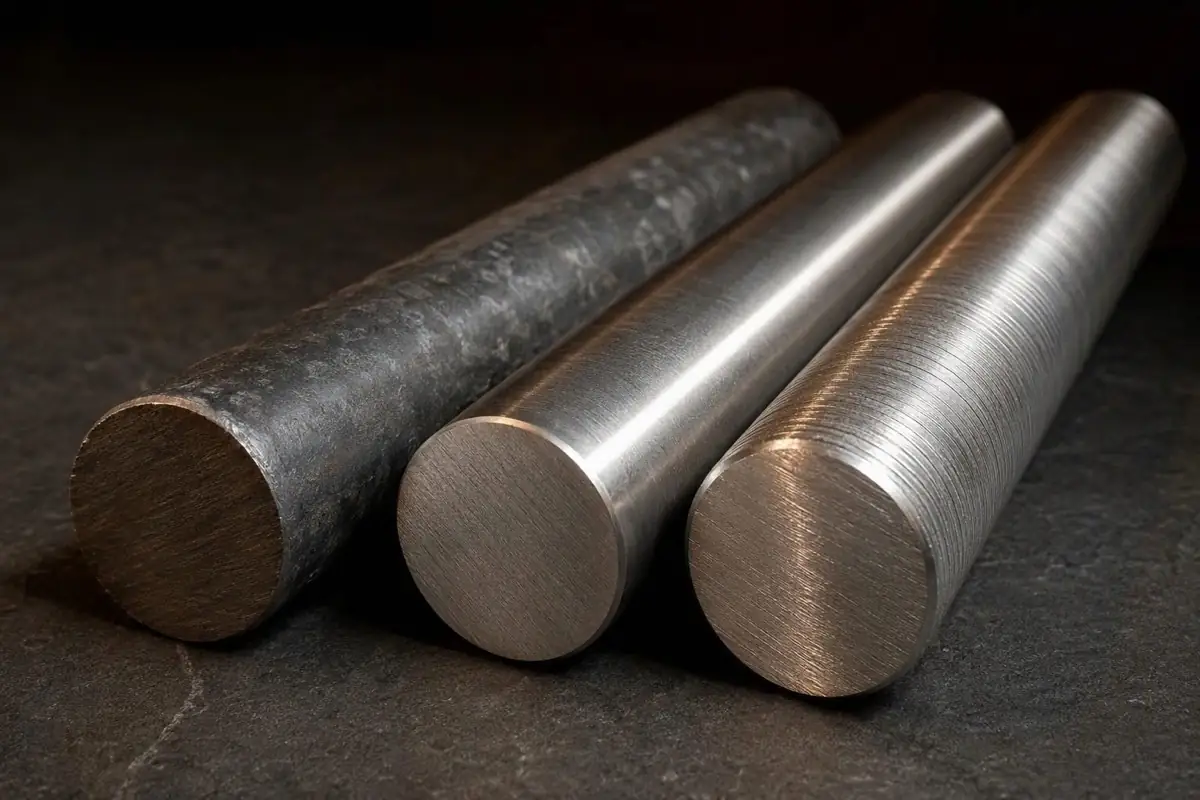
- +C (cold drawn): the hot-rolled bar is descaled and then drawn cold through a die. The surface is bright, the dimensional tolerance tight (usually h9–h11; EN 10278), and cold working raises the yield strength. However, drawing does not remove rolling defects or the decarburized layer — it only smooths over them.
- +SH (peeled): the outer skin of the bar is removed by turning (peeling), usually followed by straightening and polishing. Mill scale, surface defects and the decarburized layer are largely removed. That is why it is preferred for parts that will be induction hardened or carry high fatigue loads. The tolerance is typically around h11 and can be tightened by grinding.
According to ISO 286, for example, at 40 mm diameter the h9 tolerance is 0 / −62 µm and the h11 tolerance 0 / −160 µm; for other diameters and tolerance grades use our Tolerance Calculator. For the differences between hot-rolled and cold-drawn bar, see our hot rolled vs cold drawn comparison.
Combined Codes: The Order Is the Process Sequence
Codes can be combined, and the order in which they are written is the order of the operations:
| Code | Process sequence | When? |
|---|---|---|
| +A+C | Soft annealing → cold drawing | Bright, easily machined bar |
| +A+SH | Soft annealing → peeling | Defect-free surface, easily machined bar |
| +QT+C | Quenching and tempering → cold drawing | High-strength shafts with tight tolerance |
| +QT+SH | Quenching and tempering → peeling | Larger-diameter Q&T bar where surface defects are not acceptable |
| +C+QT | Cold drawing → quenching and tempering | The surface may scale and dimensions may change after Q&T; agree the tolerance accordingly |
Which combinations are defined with guaranteed values for which grade is set out in the relevant part of EN 10277; writing the full code on the order prevents misunderstandings with the supplier.
+AT for Stainless Steel
For austenitic stainless steels (for example 1.4301 / X5CrNi18-10), the usual delivery condition is +AT, solution annealed. For 1.4301 the material is heated to about 1000–1100 °C and cooled rapidly (in water or air). This puts chromium carbides back into solution and gives the best corrosion resistance and ductility. Austenitic stainless in condition +AT is practically non-magnetic; after cold forming it may show slight magnetism (see is steel magnetic?). Martensitic stainless grades use +A or +QT instead.
Common Mistakes
- Writing +QT without the diameter: because the guaranteed values of Q&T steel are given by size range, a request such as "+QT, 900 MPa" without a diameter is incomplete; the value can only be checked together with the size range.
- Measuring annealed material in HRC: the standards give the upper limit of condition +A in HB. The Rockwell C scale is meaningful from about 20 HRC upwards, and soft values such as 207 HB fall below that range; the hardness of annealed material should be measured and checked in HB.
- Treating +C and +SH as the same: both look bright, but a decarburized layer can remain on a cold-drawn surface. If a shaft that will be induction hardened is made from +C material, the surface hardness may turn out lower than expected.
- Writing a combined code in the wrong order: +QT+C and +C+QT are different process sequences with different tolerance, surface and mechanical values; they must be written the same way on the order, the quotation and the certificate.
- Stating the code only in the quotation: the code must also appear, unchanged, on the order confirmation, the label and the inspection document; otherwise it becomes disputable which condition the delivered material should be accepted against.
Choosing the Right Code on an Order
- If you will quench and temper the part yourself: +A; if machining and surface matter, +A+C or +A+SH.
- If the part is made straight from bar without heat treatment: +QT — always state the diameter.
- If you need a tight tolerance and a bright surface: +C; if surface defects are not acceptable, +SH.
- If the part will be induction hardened: +SH or a ground surface, to avoid the decarburized layer.
- If the part will be case hardened: +A, +TH or +FP; in series production, also a +H band.
- For structural steel: +AR or +N — and specify the impact energy requirement (JR, J0, J2, K2).
One question usually settles it: where will the final strength of the part come from — from the bar, or from your own heat treatment? If from the bar, start with +QT (with +QT+C or +QT+SH where needed); if from your own heat treatment, the +A family is the right starting point. Surface and tolerance requirements then decide between +C and +SH.
Check that the inspection document (EN 10204 3.1) states the delivery condition and that the values belong to it; our 3.1 certificate guide shows how, and the general logic of the coding systems is covered in our steel designations guide.
Supply from Aktif Çelik
🔗 See also: Quality & Certificates · How We Work
When you ask for hot rolled bars, bright steel or forged bars, write the grade together with its delivery condition code; if no code is given, we clarify it with you at the quotation stage. Request a quote for 42CrMo4+QT →
Detailed Technical Info & Quotation
Contact our expert team for detailed technical documents, application recommendations, and custom dimension quotes on this topic.