
Flange Weight
Calculator
Weight of weld neck, slip-on, blind and lap joint flanges from the ASME B16.5 and EN 1092-1 dimension tables — per piece and in total, with the formula and every dimension used.
Calculate flange weight
Choose the standard, nominal size, pressure class and flange type. Dimensions come from the same data as our flange dimensions table.
WN ASME B16.5 NPS 4" (DN100) Class 150 — 7.24 kg
Result
WN · ASME B16.5 · NPS 4" (DN100) · Class 150 · Carbon steel — A105, P250GH (7.85 g/cm³)
Dimensions used (mm)
- Outside diameter D
- 230
- Flange thickness (without RF)
- 22.3
- Bore
- 102.3
- Bolt holes
- 8 × Ø19.1
- RF diameter × height
- Ø157.2 × 1.6
- Hub diameter at base (X)
- 135
- Hub length behind the flange
- 52.7
- Hub end diameter (pipe OD)
- 114.3
Volume breakdown
- Flange plate (bore deducted)
- 743 cm³
- Bolt holes
- −51 cm³
- Raised face (RF)
- 18 cm³
- Hub
- 212 cm³
- Total volume
- 922 cm³ × 7.85 g/cm³
Approximate — calculated from nominal dimensions; actual weights vary with manufacturing tolerances and machining.
Added to your request: Flange WN, ASME B16.5 NPS 4" (DN100) Class 150, Carbon steel — A105, P250GH — 1 pcs ≈ 7.24 kg
Formula
Mass = volume × density. The volume is built from the tabulated dimensions:
V_plate = π/4 · (D² − B²) · t − n · π/4 · L² · t
V_RF = π/4 · (G² − B²) · f
V_hub (WN) = π·h/12 · (X² + X·A + A²) − π/4 · B² · h
V_hub (SO, LJ) = π/4 · (X² − B²) · h
m = (V_plate + V_RF + V_hub) · ρ
D outside diameter, B bore, t thickness, n number of bolt holes, L hole diameter, G RF diameter, f RF height, X hub diameter at base, A pipe OD, h hub length, ρ density.
Assumptions
- ASME B16.5: NPS 1/2–24, Class 150–2500, metric dimension tables. EN 1092-1: DN15–600, PN6–PN40; Type 11 (weld neck), Type 01 (plate slip-on) and Type 05 (blind). A combination the source table does not list is not calculated.
- The raised face is included: 1.6 mm for Class 150/300 and 6.4 mm for Class 600 and above (ASME), f1 for EN Type 11. EN Type 01 and Type 05 are calculated as flat discs.
- The WN hub is modelled as a truncated cone from its base diameter to the pipe OD (EN Type 11 with its straight weld end); SO and LJ hubs are taken as cylinders, so those results come out slightly high.
- Fillets, chamfers, facing finish and ring-joint grooves are ignored.
- Densities: 7.85 g/cm³ for carbon and low-alloy steel, 7.93 g/cm³ for 304/304L, 7.98 g/cm³ for 316/316L — the same values as our steel density table.
- Use the result for freight, handling and quotation estimates; the weight on a packing list is the weighed weight.
Need these flanges?
Send us the size, class, type and material — we reply with a quote within 24 hours. Flanges are supplied with EN 10204 3.1 certificates.
Request a QuoteHow much does a flange weigh?
A flange weighs its volume times the density (7.85 g/cm³ for carbon steel). Calculated from the ASME B16.5 dimensions, an NPS 4" Class 150 weld neck flange weighs about 7.2 kg, a slip-on 5.4 kg and a blind flange 7.1 kg; in Class 300 the weld neck rises to about 11.7 kg. An EN 1092-1 DN100 PN16 weld neck flange (Type 11) weighs about 4.4 kg. A 316 stainless flange of the same size is about 1.7 % heavier than a carbon steel one (7.98 / 7.85 g/cm³).
What determines the weight of a flange?
The pressure class changes the weight most: outside diameter, thickness and hub length all grow with the class. An NPS 4" weld neck flange weighs about 7.2 kg in Class 150 and 11.7 kg in Class 300. The type matters too: the long hub makes a weld neck heavier than a slip-on, and because a blind flange has no bore it is the heaviest type in large sizes (NPS 12" Class 150: blind 43.8 kg, weld neck 38.8 kg). ASME and EN flanges of the same nominal size are not interchangeable, and their weights differ as well: an ASME Class 150 flange is thicker and has a longer hub than an EN PN16 flange — at DN100 the weld neck weighs 7.2 kg against 4.4 kg. Quotations and freight estimates should therefore always state standard, class and type together. The calculated weight is based on nominal dimensions. A real part weighs slightly differently depending on manufacturing tolerances, machining allowances and surface finish; the packing list carries the weighed weight.
Approximate flange weights (carbon steel, kg/pc)
| Size | ASME 150 WN | ASME 150 SO | ASME 150 Blind | EN PN16 Type 11 | EN PN16 Type 01 | EN PN16 Type 05 |
|---|---|---|---|---|---|---|
| NPS 2" / DN50 | 2.6 | 2.0 | 2.4 | 2.5 | 2.7 | 2.9 |
| NPS 4" / DN100 | 7.2 | 5.4 | 7.1 | 4.4 | 4.4 | 5.6 |
| NPS 6" / DN150 | 11.1 | 7.5 | 11.4 | 7.4 | 7.1 | 10.5 |
| NPS 8" / DN200 | 18.5 | 12.4 | 19.9 | 11.0 | 9.7 | 16.2 |
| NPS 12" / DN300 | 38.8 | 26.7 | 43.8 | 21.2 | 19.0 | 35.1 |
Calculated with this tool from nominal dimensions (7.85 g/cm³); actual weights vary with manufacturing.
Frequently Asked Questions
How much does a 4 inch Class 150 flange weigh?+
From ASME B16.5 dimensions, in carbon steel, approximately: weld neck (WN) 7.2 kg, slip-on (SO) 5.4 kg, blind 7.1 kg, lap joint (LJ) 5.6 kg.
What does a DN100 PN16 flange weigh?+
From EN 1092-1 dimensions, in carbon steel, approximately: weld neck (Type 11) 4.4 kg, plate slip-on (Type 01) 4.4 kg, blind (Type 05) 5.6 kg.
Why can a blind flange be heavier than a weld neck flange?+
A blind flange has no bore. In small sizes the weld neck hub makes up for that (NPS 2" Class 150: WN 2.6 kg, blind 2.4 kg); in large sizes the missing bore dominates (NPS 12": blind 43.8 kg, WN 38.8 kg).
How do I calculate flange weight by hand?+
Flange ring π/4 · (D² − B²) · t, minus the bolt holes, plus the raised face and hub volumes; multiply the total volume by the density. The calculator shows every step and the dimensions it uses.
Is a stainless steel flange heavier?+
Slightly: at the same size a 304/304L flange is about 1.0 % and a 316/316L flange about 1.7 % heavier than carbon steel; the difference comes from density alone (7.93 and 7.98 g/cm³).
Why do ASME and EN flanges of the same size weigh differently?+
Their dimensions differ: an ASME Class 150 flange is thicker and has a longer hub than an EN PN16 flange. For a DN100 weld neck the difference is about 7.2 kg against 4.4 kg. The connecting dimensions of the two standards do not match either.
Are flanges above NPS 24 covered?+
No. ASME B16.5 ends at NPS 24; larger sizes fall under ASME B16.47 (Series A/B), which this tool does not include. On the EN side the data go up to DN600.
Related Products
Related Sectors
Related Blog Posts
Technical articles, guides and industry analyses
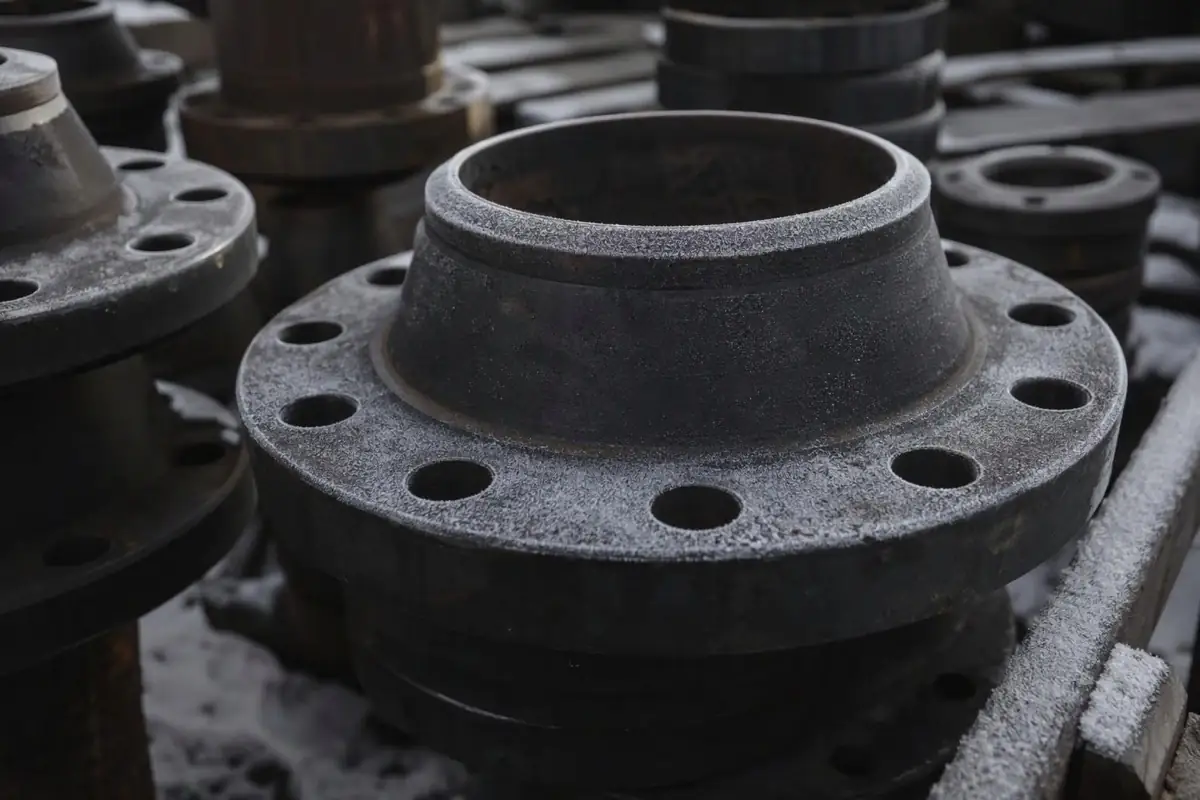
A105 vs A350 LF2: Which Flange Material for Low Temperatures?
A105 and A350 LF2 are two forged carbon steels of the same strength; the real difference is impact testing. LF2 Class 1 is guaranteed by a notch impact test at −46 °C, while A105 has no mandatory impact test. Chemistry and mechanical table, the window that meets both standards, and a flange–pipe–fitting set by design temperature.
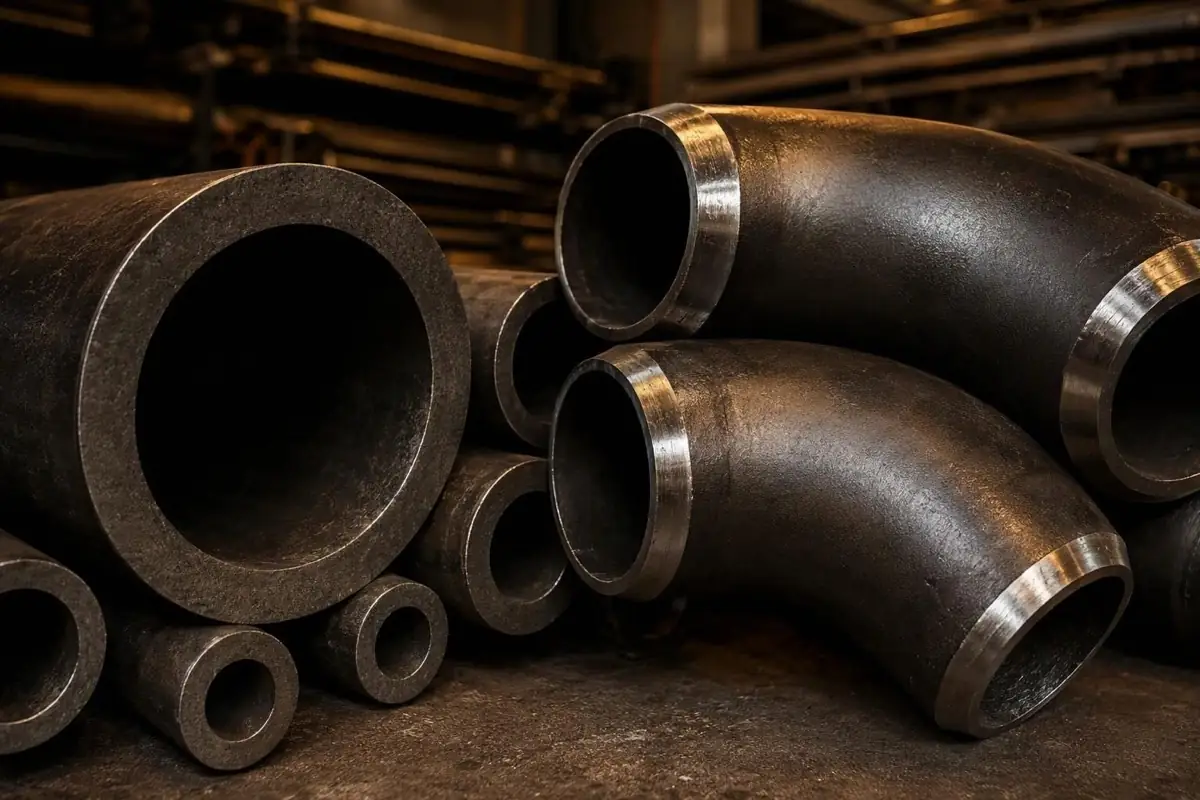
Matching Fittings and Flanges to Pipe Schedule: SCH 80, SCH 160, XXS
Schedule is the pipe's wall thickness; fittings and flanges carry the same information in different ways. On butt-weld fittings the schedule follows the pipe, on socket-weld and threaded fittings the class does, and on weld neck flanges the bore does. We put the matching rules for SCH 160 and XXS lines and our calculated weight table in one place.