A105 vs A350 LF2: Which Flange Material for Low Temperatures?
A105 and A350 LF2 are two forged carbon steels of the same strength; the real difference is impact testing. LF2 Class 1 is guaranteed by a notch impact test at −46 °C, while A105 has no mandatory impact test. Chemistry and mechanical table, the window that meets both standards, and a flange–pipe–fitting set by design temperature.
📋 Comparison: A105 vs P250GH → · Product: Flanges · Tool: Pressure Class
Short Answer
A105 and A350 LF2 are two forged carbon steels with almost identical strength; what separates them is low-temperature toughness. ASTM A105 covers forged piping components for ambient- and higher-temperature service and does not require an impact test. ASTM A350 is the standard for low-temperature forgings that must pass a notch impact test. LF2 Class 1 must pass a Charpy test at −46 °C. So when the design temperature goes well below zero, the flange is LF2, not A105. The design code has the final word: the material table of ASME B31.3 lists −29 °C as the minimum temperature for A105.
Chemistry and Mechanical Comparison
| Property | A105 | A350 LF2 | Window meeting both |
|---|---|---|---|
| C (%) | ≤ 0.35 | ≤ 0.30 | ≤ 0.30 |
| Mn (%) | 0.60–1.05 | 0.60–1.35 | 0.60–1.05 |
| Si (%) | 0.10–0.35 | 0.15–0.30 | 0.15–0.30 |
| P (%) | ≤ 0.035 | ≤ 0.035 | ≤ 0.035 |
| S (%) | ≤ 0.040 | ≤ 0.040 | ≤ 0.040 |
| Other elements | Cu, Ni, Cr, Mo, V each limited; total ≤ 1.00 | Ni ≤ 0.40 · Cr ≤ 0.30 · Mo ≤ 0.12 · Cu ≤ 0.40 · V ≤ 0.08 · Nb ≤ 0.02; total ≤ 1.00 | The stricter of the two lists |
| Tensile strength (MPa) | ≥ 485 | 485–655 | 485–655 |
| Yield strength (MPa) | ≥ 250 | ≥ 250 | ≥ 250 |
| Elongation (%) | ≥ 22 | ≥ 22 | ≥ 22 |
| Hardness (HBW) | ≤ 187 | ≤ 197 | ≤ 187 |
| Notch impact test | Not mandatory | Class 1: −46 °C, avg. 20 J / single 16 J · Class 2: −18 °C, avg. 27 J / single 20 J | Requirement of the LF2 class |
| Heat treatment | Mandatory for certain pressure classes and sizes (annealing, normalizing, N+T, Q+T) | Normalizing, N+T or Q+T (tempering ≥ 590 °C after Q) | Normalized or N+T is common |
Source: ASTM A105/A105M and ASTM A350/A350M. We derived the last column by taking the stricter limit of the two standards in each row. The specimen type for elongation is defined in each standard.
Two conclusions follow. First, the strength difference is negligible: both steels have a minimum yield of 250 MPa and a minimum tensile strength of 485 MPa; LF2 also has an upper tensile limit of 655 MPa. Second, the chemistry windows largely overlap. A forging with carbon at or below 0.30%, manganese at or below 1.05% and hardness under 187 HBW can meet both standards at once. That is why dual-certified (A105/A350 LF2) flanges are common in the market.
The Decisive Difference: Impact Testing and the Ductile–Brittle Transition
As temperature falls, carbon steel moves from ductile to brittle behaviour. The transition shows up as a drop in the energy absorbed in a Charpy V-notch impact test. If a flange operates in the brittle range, a small defect or a sudden load can cause fracture without plastic deformation.
- A105 is a steel whose strength and chemistry are guaranteed; its low-temperature toughness is not. An impact test can be ordered as a supplementary requirement, but the standard does not require it on its own.
- A350 LF2 is a steel whose toughness is proven at a specified temperature. Class 1 requires at least 20 J at −46 °C as the average of a three-specimen set; Class 2 guarantees higher energy (27 J average) at a milder temperature (−18 °C).
The design code decides which material needs impact testing at which temperature. In ASME B31.3 the decision depends on the listed minimum temperature of the material, the wall thickness and the stress ratio. The thresholds in this article are a starting point; what binds the project is the calculation under the applicable code.
Material Set by Design Temperature
Choosing the flange alone is not enough; the pipe and fittings on the same line must belong to the same temperature class. The table below brings together the ASTM grades used together in low-temperature service.
| Minimum design temperature | Flange and forged fitting | Pipe | Butt-weld fitting | Note |
|---|---|---|---|---|
| −29 °C and above | A105 / A105N | A106 Gr. B | A234 WPB | −29 °C is the minimum listed for A105 in the B31.3 table |
| Between −29 °C and −46 °C | A350 LF2 Class 1 | A333 Gr. 6 | A420 WPL6 | LF2 Class 1 impact test at −46 °C |
| Below −46 °C | A350 LF3 (3.30–3.70% Ni) | A333 Gr. 3 | A420 WPL3 | Confirm the impact test temperature from the current standard table when ordering |
| Cryogenic service (e.g. LNG) | A182 F304L / F316L | A312 TP304L / TP316L | A403 WP304L / WP316L | Austenitic stainless; impact requirements per design code |
Set compiled by us; the temperature thresholds are based on the ASTM A350 impact test temperatures and the A105 value in the ASME B31.3 material table. For the Cr-Mo sets on the high-temperature side (A182 F11, F22), see our A234 WPB, WP11 and WP22 article.
What Does A105N Mean?
"A105N" is not a separate grade in ASTM; it is a market designation for normalized A105. Normalizing refines the grain structure and improves toughness, but it does not guarantee an impact value. A105N therefore does not replace LF2 in a service that requires impact testing. If a specification only says "A105N" and the line will run at low temperature, the impact test and its temperature must be stated separately.
Welding, Pressure Class and Dimensions
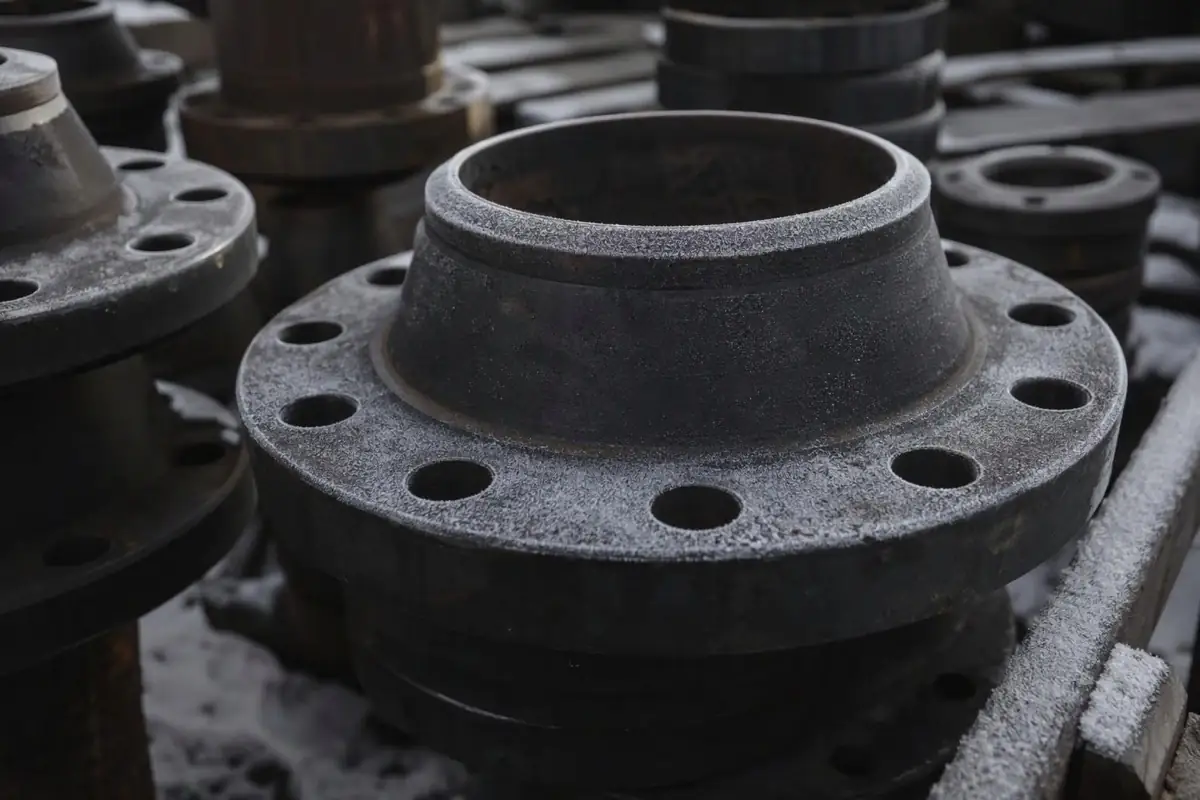
- Dimensions are the same: A105 and LF2 flanges are made to the same ASME B16.5 dimension tables. You can check dimensions with the Flange Dimensions tool and weight with the Flange Weight tool.
- Pressure class depends on the material group: ASME B16.5 gives pressure–temperature ratings by material group. Check the material's group in the standard's table; use the Pressure Class tool for the calculation.
- Welding: Both are carbon-manganese steels and weld well. In low-temperature service, however, the welding procedure is qualified with weld metal and HAZ impact tests where the code requires them. If post-weld heat treatment is applied, its effect on impact values is considered in the procedure.
Which One Should You Choose?
- Ambient and high-temperature service, no impact requirement: A105 or A105N.
- Design temperature below −29 °C, or the code requires impact testing: A350 LF2 Class 1.
- Higher impact energy required at moderately low temperature: A350 LF2 Class 2 (27 J average at −18 °C).
- Below −46 °C: A350 LF3 or austenitic stainless steel, verified by the code calculation.
- Stock and project flexibility: in projects with both ambient and low-temperature lines, dual-certified A105/LF2 flanges can reduce the number of line items; the certificate must show the results for both standards.
What to Write in the Specification
- Standard, grade and class: e.g.
ASTM A350 LF2 Class 1 - Flange type, dimension standard and pressure class: e.g.
WN RF, ASME B16.5, Class 300, NPS 6, SCH 40 bore - Impact test: temperature and energy (state explicitly if different from the standard)
- Heat-treatment condition: normalized, N+T or Q+T
- If dual certification is required:
A105/A105N + A350 LF2 Cl.1, with test results for both standards - Certificate: EN 10204 3.1; third-party inspection by SGS, Bureau Veritas or TÜV on request
Frequently Asked Questions
Can A105 be used at low temperature?
The ASME B31.3 material table lists −29 °C as the minimum temperature for A105. Below that, the code's impact testing and exemption rules apply; in practice, most projects switch to A350 LF2 in this case.
What is the difference between LF2 Class 1 and Class 2?
Class 1 requires an average of 20 J (single specimen 16 J) at −46 °C. Class 2 guarantees higher energy (average 27 J, single specimen 20 J) at a higher temperature, −18 °C. Tensile and yield requirements are the same for both classes.
Are A105N and A350 LF2 the same?
No. A105N is normalized A105, and its impact value is not guaranteed. LF2 is a steel that has passed an impact test at a specified temperature. A forging can be produced to meet both standards and supplied with dual certification.
Does an LF2 flange have the same dimensions as an A105 flange?
Yes. Both are made to ASME B16.5 (or B16.47) dimensions; the difference is in the material and the testing, not the geometry.
Supply from Aktif Çelik
We supply weld neck, slip-on, blind and threaded flanges in A105/A105N and A350 LF2, together with matching olets and forged connection fittings and butt-weld fittings, with an EN 10204 3.1 inspection certificate. Put requirements such as impact test temperature, class and dual certification in your request; we will confirm availability with the producers in our supply network. Quotations are sent within 24 hours; lead time and minimum quantity vary by product and are stated in the quote.
🔗 See also: Quality & Certificates · Flange Types Guide
Detailed Technical Info & Quotation
Contact our expert team for detailed technical documents, application recommendations, and custom dimension quotes on this topic.