ASTM A234 WPB vs WP11 vs WP22: Which Fitting Material When?
A234 WPB is a carbon steel fitting; WP11 (1¼Cr-½Mo) and WP22 (2¼Cr-1Mo) are chrome-moly alloys for high-temperature and creep service. We compare the grade codes, the chemistry and strength values in the standard, the P-numbers that matter for welding, and the pipe–fitting–flange material sets by service condition.
🔩 Products: Fittings · 90° elbow · Tee · Comparison: A105 vs P250GH
Short Answer
ASTM A234 is the material standard for wrought carbon and alloy steel pipe fittings for moderate and high-temperature service. WPB is its carbon steel grade and the default fitting for general process, water, steam and hydrocarbon lines from ambient to moderate temperatures. WP11 (nominal 1¼Cr–½Mo) and WP22 (nominal 2¼Cr–1Mo) are chrome-moly alloys. They are used in steam, hot oil and hydrogen service, where carbon steel weakens after long exposure to high temperature.
The practical rule is simple: the fitting follows the material family of the pipe it is welded to. A106 Grade B pipe takes WPB fittings, A335 P11 pipe takes WP11 and A335 P22 pipe takes WP22. Mix the families and the welding procedure, preheat and post-weld heat treatment requirements change, and the odd material becomes the weakest link in the line.
How to Read the Grade Code
The common industry reading of A234 grade names is: W for weldable, P for pressure service, and the final letter or number identifies the grade. The B in WPB is one of the carbon steel grades; WPC is a higher-strength carbon steel in the same family. The numbers in WP11 and WP22 identify the alloy family, and these grades are further divided into strength levels: WP11 comes in Class 1, 2 and 3, WP22 in Class 1 and 3 (e.g. WP11 CL2, WP22 CL3). If the class is not written on the order, the lowest strength level may be supplied. Whatever level the design is based on must be stated explicitly.
Fittings made by welded construction carry a W suffix in their marking (e.g. WPBW). If seamless fittings are required, "seamless" must be stated separately on the order.
Chemistry and Mechanical Values
| Property | WPB | WP11 Class 1 | WP22 Class 1 |
|---|---|---|---|
| Nominal composition | Carbon steel | 1¼Cr–½Mo | 2¼Cr–1Mo |
| C (%) | ≤ 0.30 | 0.05–0.15 | 0.05–0.15 |
| Mn (%) | 0.29–1.06 | 0.30–0.60 | 0.30–0.60 |
| Si (%) | ≥ 0.10 | 0.50–1.00 | ≤ 0.50 |
| Cr (%) | ≤ 0.40 (residual) | 1.00–1.50 | 1.90–2.60 |
| Mo (%) | ≤ 0.15 (residual) | 0.44–0.65 | 0.87–1.13 |
| Min. yield (MPa) | 240 | 205 | 205 |
| Min. tensile (MPa) | 415 | 415 | 415 |
| ASME IX P-No. | 1 | 4 | 5A |
| Matching pipe | A106 Gr. B / A53 Gr. B | A335 P11 | A335 P22 |
| Matching forging (flange, olet) | A105 | A182 F11 | A182 F22 |
Source: ASTM A234/A234M (Class 1 values); P-numbers from ASME BPVC Section IX. Residual limits for WPB such as Ni, Cu and V are not listed.
The most striking row is strength. At Class 1, the minimum room-temperature yield strength of WP11 and WP22 is lower than that of WPB. The advantage of chrome-moly fittings shows not at room temperature but under sustained load at high temperature. Fitting selection is governed by the allowable stresses at design temperature, not by room-temperature values.
The Deciding Difference: Temperature and Time
Carbon steel faces two problems at high temperature. The first is creep: permanent elongation over time under constant load. The second is graphitization. According to the material notes of ASME B31.3, when carbon steel is held above 425 °C for long periods, its carbides can transform to graphite and the joint weakens. Chromium and molybdenum change this behaviour:
- Molybdenum increases creep strength and keeps carbides stable.
- Chromium increases oxidation resistance and carbide stability at high temperature.
- In hydrogen service (such as refinery hydroprocessing units), Cr-Mo selection against high-temperature hydrogen attack is made with the Nelson curves in API RP 941.
No single number defines how hot a grade can go. ASME B31.3 Table A-1, B31.1 and BPVC Section II-D give the allowable stress of each material as a function of temperature, and the design uses the value taken from these tables. So instead of generalizations like "WP11 is good up to X degrees", check the table value at the project's design temperature. To check the pressure–temperature class of the flange, use the Pressure Class tool.
The Welding and Heat Treatment Difference
Choosing the material is also a welding decision:
- WPB (P-No. 1): In the same welding procedure group as carbon steel pipe and A105 flanges. Under A234, WPB fittings whose final forming is completed hot, in roughly the 620–980 °C range, do not require heat treatment. Cold-formed ones are normalized or stress relieved at 595–690 °C.
- WP11 (P-No. 4) and WP22 (P-No. 5A): The fittings are supplied annealed or normalized and tempered. Welding requires a matching alloy filler metal (B2-class electrodes and wires for 1¼Cr–½Mo, B3-class for 2¼Cr–1Mo), preheat, and post-weld heat treatment (PWHT) under the conditions the piping code specifies. The requirements are read from the code's tables by P-number and wall thickness.
That is why a carbon steel fitting in a Cr-Mo line is not just a material error. It also means a dissimilar weld and a separate heat treatment plan.
Material Sets by Service Condition
The table below shows, on a single row, which ASTM families the pipe, fitting, flange and branch items of the same line come from. Looking at it item by item shows why thinking "fitting here, flange there" invites mistakes.
| Service | Pipe | Butt-weld fitting | Flange and forged fitting | P-No. |
|---|---|---|---|---|
| General carbon steel line | A106 Gr. B | A234 WPB | A105 / A105N | 1 |
| Low temperature (impact tested) | A333 Gr. 6 | A420 WPL6 | A350 LF2 | 1 |
| High temperature, 1¼Cr–½Mo | A335 P11 | A234 WP11 | A182 F11 | 4 |
| High temperature, 2¼Cr–1Mo | A335 P22 | A234 WP22 | A182 F22 | 5A |
| Stainless, 316L | A312 TP316L | A403 WP316L | A182 F316L | 8 |
Compiled from the material families of the ASTM product standards. Final selection follows the project's material specification (piping class).
For the chemistry and equivalents of the stainless grade in the last row, see our 316L datasheet. The European counterpart of the carbon steel forged flange material is covered in the A105 vs P250GH comparison. To compare the analysis on a certificate with the standard ranges, use the Chemical Composition tool.
Which One to Choose?
Choose WPB if:
- The line is carbon steel (A106 B / A53 B) and the design temperature stays within carbon steel's allowable stress table
- There is no long-term service above 425 °C
- You want the widest manufacturer base and the shortest supply route
Choose WP11 if:
- The line is A335 P11: steam, superheated water and high-temperature process lines
- Carbon steel's creep and graphitization limits are being approached
Choose WP22 if:
- The line is A335 P22: higher temperatures or longer expected life
- In hydrogen service, the Nelson curves point to 2¼Cr–1Mo
For even higher temperatures, grades such as 9Cr–1Mo–V (WP91) are also covered by A234, but they require their own heat treatment and welding discipline.
What to Write in the Specification
- Material: grade and class together, e.g.
ASTM A234 WP11 CL2. - Construction: seamless or welded; if welded, the inspection requirement for the welds.
- Dimensions: type, NPS and schedule (ASME B16.9); end preparation to ASME B16.25. For schedule matching, see our schedule guide and the DN-NPS tool.
- Heat treatment condition: must be stated on the certificate (for Cr-Mo, annealed or normalized + tempered).
- Supplementary requirements: hardness limit for sour service (NACE MR0175 / ISO 15156); positive material identification (PMI) if required.
- Documents: EN 10204 3.1; on request, third-party inspection by SGS, Bureau Veritas or TÜV.
Frequently Asked Questions
What is the difference between A234 WPB and A105?
Both are carbon steels in the same P-No. 1 group. WPB is the material for butt-weld fittings (elbows, tees, reducers) formed from pipe or plate. A105 is the material for forged parts such as flanges, socket-weld fittings and olets. They are used together on the same line.
Can WP22 be used instead of WP11?
Not without engineering approval. Chemistry, welding filler metal and heat treatment are different. Being more highly alloyed does not make WP22 a substitute in every case. Changing the piping class requires the designer's approval.
Can WPB be used at high temperature?
Yes, at temperatures that stay within carbon steel's allowable stress table. ASME B31.3 warns of graphitization risk in long-term use above 425 °C. In that range, Cr-Mo grades are evaluated.
What is the difference between WP11 Class 1, 2 and 3?
The chemistry family is the same; the strength level differs. Class 1 has the lowest minimum yield and tensile values, Classes 2 and 3 are higher. The class used in the design must be written explicitly on the order.
Sourcing from Aktif Çelik
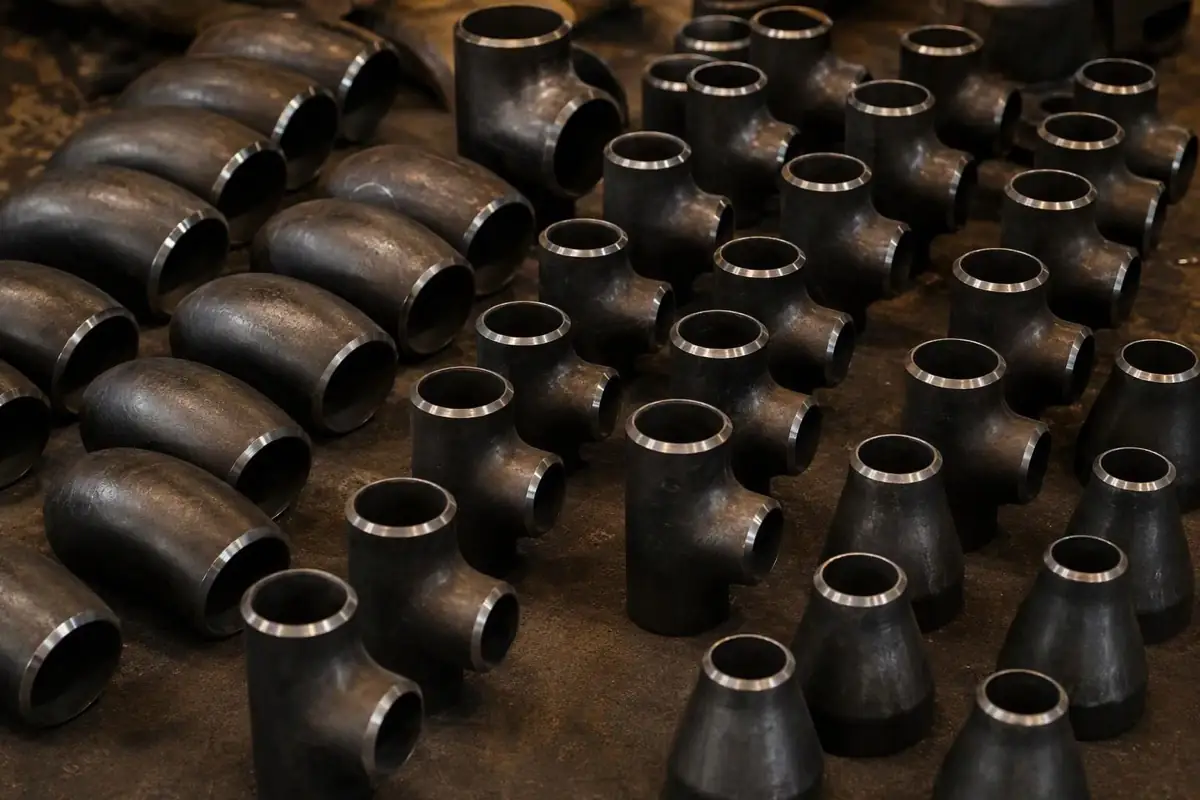
We supply butt-weld elbows, tees, reducers and caps in A234 WPB as well as alloy grades such as WP11 and WP22, together with matching flange and olet items. Every item comes with an EN 10204 3.1 inspection certificate, and third-party inspection can be arranged on request. Send your material list with grade and class, and we will confirm suitability with the manufacturers in our supply network. Quotes are sent within 24 hours; lead time and minimum quantity vary by product and are stated in the quote.
🔗 See also: Quality & Certificates · How to read an EN 10204 3.1 certificate
Detailed Technical Info & Quotation
Contact our expert team for detailed technical documents, application recommendations, and custom dimension quotes on this topic.