
Hardness to Tensile
Strength Calculator
Estimate the tensile strength (Rm, MPa) of steel from HRC, HB, HV or HRB per ISO 18265 Table A.1 — with the table rows used and the range limits.
Convert hardness to tensile strength
Choose the scale and enter the measured hardness. No result is given outside the table range.
For HRC, tensile strength is given from 20.3 to 57.8.
Enter a hardness value to see the tensile strength.
Why is this result approximate?
- The relationship between hardness and tensile strength is empirical; the actual value of an individual part can deviate from the table. Treat the result as an estimate.
- Table A.1 covers unalloyed and low-alloy steels and cast steel. Do not use it for austenitic stainless steels, cold-worked material, case-hardened or induction-hardened surfaces, or non-ferrous metals.
- For acceptance and certificates, tensile strength is measured by a tensile test (ISO 6892-1 / ASTM A370); an EN 10204 3.1 certificate reports the measured value.
- The tool does not extrapolate: it gives no value outside the table range.
Hardness vs tensile strength — ISO 18265 Table A.1 rows
Selected rows; an empty cell means the table does not give that scale in that region.
| HV | HBW | HRB | HRC | Rm (MPa) |
|---|---|---|---|---|
| 100 | 95 | 56.2 | – | 320 |
| 150 | 143 | 78.7 | – | 480 |
| 200 | 190 | 91.5 | – | 640 |
| 250 | 238 | 99.5 | 22.2 | 800 |
| 300 | 285 | – | 29.8 | 965 |
| 350 | 333 | – | 35.5 | 1,125 |
| 400 | 380 | – | 40.8 | 1,290 |
| 450 | 428 | – | 45.3 | 1,455 |
| 500 | 475 | – | 49.1 | 1,630 |
| 550 | 523 | – | 52.3 | 1,810 |
| 600 | 570 | – | 55.2 | 1,995 |
| 650 | 618 | – | 57.8 | 2,180 |
Method: Values are taken exactly from ISO 18265 (formerly DIN 50150) Annex A, Table A.1; intermediate values are linearly interpolated between the two neighbouring rows. The table gives Rm from 80 to 650 HV (255–2180 MPa). ksi = MPa × 0.145; kgf/mm² = MPa ÷ 9.807.
Full hardness conversion tableGrade datasheets
Tensile strength ranges from the material standards, by delivery condition, are listed in our datasheets.
Looking for steel with a specific strength?
Send us the grade, delivery condition and size — we reply with a quote within 24 hours. Material is supplied with EN 10204 3.1 certificates.
Request a QuoteHow do you convert hardness to tensile strength?
For unalloyed and low-alloy steels, ISO 18265 Table A.1 lists an approximate tensile strength next to each hardness value: 200 HV ≈ 190 HB ≈ 640 MPa, 300 HV ≈ 285 HB ≈ 29.8 HRC ≈ 965 MPa, 400 HV ≈ 380 HB ≈ 40.8 HRC ≈ 1290 MPa, 500 HV ≈ 475 HB ≈ 49.1 HRC ≈ 1630 MPa. Across the table Rm is about 3.2–3.4 times the Vickers value and 3.3–3.5 times the Brinell value. The table gives tensile strength from 80 to 650 HV (255–2180 MPa); the result is an estimate and does not replace a tensile test.
Where the hardness–strength relationship holds, and where it does not
Hardness and tensile strength both measure a material's resistance to plastic deformation, by different routes, so within one material group they correlate well. ISO 18265 (the successor of DIN 50150) therefore gives separate tables for different material groups; Table A.1, used here, covers unalloyed and low-alloy steels and cast steel. The correlation weakens where the microstructure or work hardening differs from the steels the table is based on: austenitic stainless steels, cold-drawn or cold-rolled material and parts with a hardened surface layer. A reading taken on a hardened surface says nothing about the strength of the core. In practice the conversion is used to check heat-treated parts, to estimate the strength of an unknown bar before testing, or to compare a hardness requirement on a drawing with the tensile range in a material standard. For acceptance, the tensile test to ISO 6892-1 remains the reference; an EN 10204 3.1 inspection certificate reports the measured Rm, Rp0.2 and elongation.
Frequently Asked Questions
What tensile strength does 30 HRC correspond to?+
About 970 MPa (ISO 18265 Table A.1; the nearest row is 29.8 HRC = 300 HV = 965 MPa). 30 HRC ≈ 302 HV ≈ 287 HB.
How many MPa is 200 HB?+
About 678 MPa per Table A.1: linear interpolation between the rows 199 HB = 675 MPa and 204 HB = 690 MPa.
Is Rm = 3.3 × HB correct?+
Rules of thumb like this exist, but the factor is not constant: in Table A.1 the ratio Rm/HB varies between about 3.3 and 3.5 depending on the hardness level. Using the table with interpolation avoids that error; for stainless steels and non-ferrous metals the factor is different again.
Can hardness above 58 HRC be converted to tensile strength?+
No. Table A.1 gives tensile strength only up to 650 HV (≈ 57.8 HRC, 2180 MPa); above that only hardness scales are listed, so the tool gives no tensile value there.
Can I use it for 304 or 316 stainless steel?+
No. Austenitic stainless steels work-harden differently and are outside the scope of Table A.1; take their tensile strength from a tensile test or the material standard (e.g. EN 10088-3).
Which hardness should I enter for a case-hardened part?+
The core hardness measured on a section, not the surface hardness. The case is much harder than the core, while tensile strength depends on the whole cross-section.
What is kgf/mm² and how does it convert to MPa?+
Older drawings and GOST documents give strength in kgf/mm². 1 kgf/mm² = 9.807 MPa, so 100 kgf/mm² ≈ 981 MPa. The tool shows the result in MPa, ksi and kgf/mm².
Related Products
Related Sectors
Related Blog Posts
Technical articles, guides and industry analyses
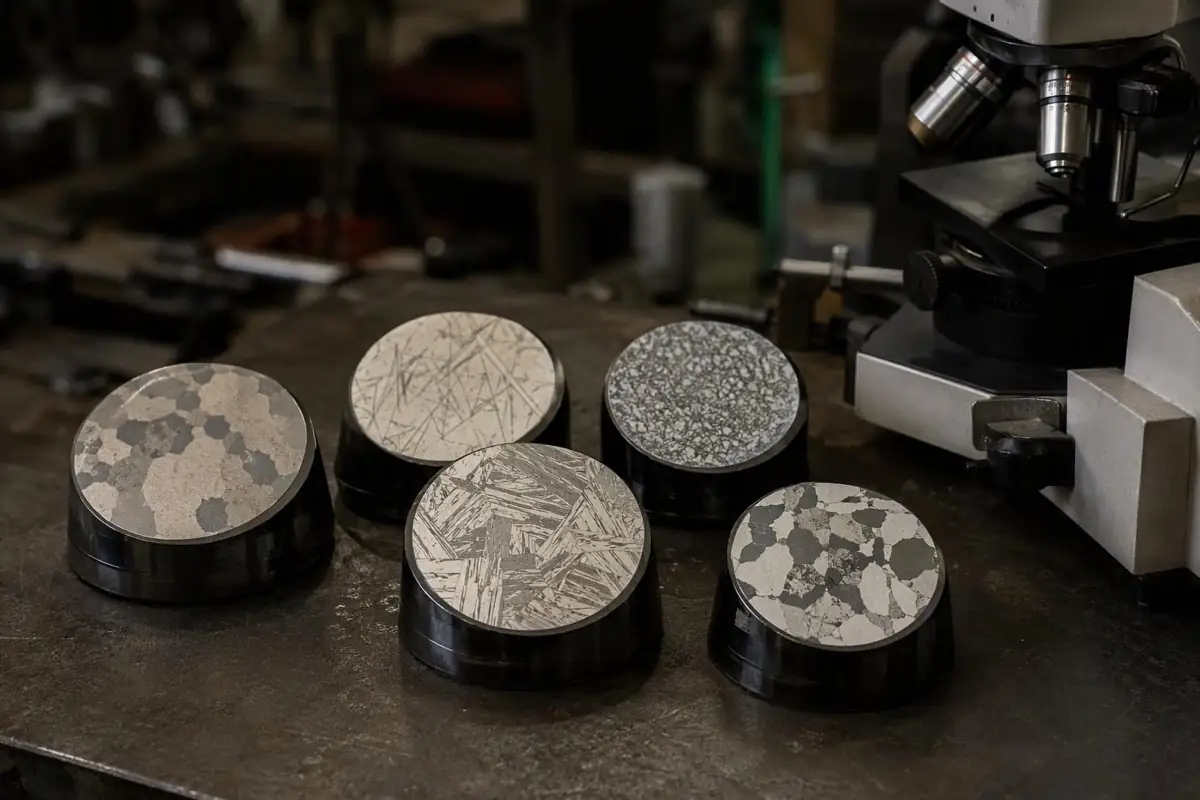
Steel Cleanliness: How ISO 4967 Rates Non-Metallic Inclusions
Steel cleanliness measures the type, size and amount of oxide, sulphide and silicate inclusions in steel. We explain the A, B, C, D and DS types and methods A and B of ISO 4967, how it differs from ASTM E45 and EN 10247, and what to write in the specification for bearing steels or fatigue-loaded shafts.
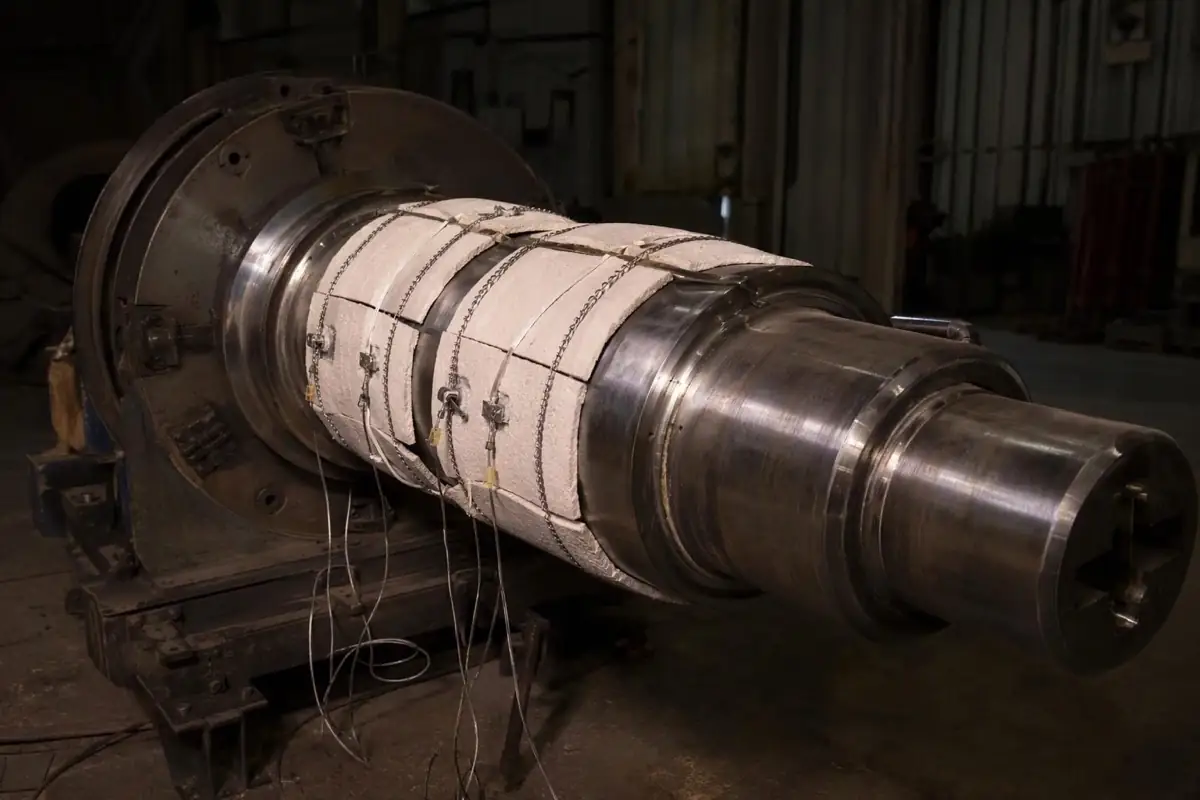
Welding 42CrMo4: Preheat, Interpass and PWHT for Q&T Steels
42CrMo4 and other quenched and tempered steels can be welded, but only under conditions: preheat, low-hydrogen consumables, controlled interpass temperature and post-weld heat treatment. The rule most often missed: on a quenched and tempered part, PWHT must not exceed the tempering temperature of the material. Datasheet values, the EN 1011-2 calculation and a work-order checklist.