
Free-Cutting Steel Grades: Choosing from 11SMn30 to 44SMn28
Free-cutting steel is more than 11SMn30 and 11SMnPb30. EN ISO 683-4 (formerly EN 10087) splits these steels into three groups: not intended for heat treatment, suitable for case hardening and suitable for quenching and tempering. Chemistry table, how machinability works and which grade suits which part.
📋 11SMn30 Datasheet → · 11SMnPb30 Datasheet → · Product: Free-cutting steels
Short Answer
Free-cutting steel is steel with deliberately raised sulphur (and, in some grades, lead) so that the chip breaks into short pieces. Sulphur combines with manganese to form manganese sulphide (MnS) inclusions. In the cutting zone these inclusions split the chip, extend tool life and improve the surface finish. EN ISO 683-4 (formerly EN 10087) divides free-cutting steels into three groups: grades not intended for heat treatment (11SMn30, 11SMn37 and their leaded versions), grades suitable for case hardening (10S20, 15SMn13) and grades suitable for quenching and tempering (35S20, 36SMn14, 38SMn28, 44SMn28, 46S20).
Three questions decide the right grade: Will the part be heat treated? What strength is required? Is lead acceptable?
Which Standard Applies?
For many years the free-cutting grade names were defined by EN 10087:1998. That standard has now been replaced by EN ISO 683-4, which sets the technical delivery conditions for hot-rolled and semi-finished products. Bright bars (cold drawn, peeled, ground) fall under EN 10277; its 2018 edition merged the former five parts into a single standard. Grade names and chemical composition are the same in both standards. In the order it is enough to name the standard that matches the product form.
Chemical Composition Table
| Grade | Mat. No. | C | Si | Mn | P max | S | Pb |
|---|---|---|---|---|---|---|---|
| Not intended for heat treatment | |||||||
| 11SMn30 | 1.0715 | ≤ 0.14 | ≤ 0.05 | 0.90–1.30 | 0.11 | 0.27–0.33 | — |
| 11SMnPb30 | 1.0718 | ≤ 0.14 | ≤ 0.05 | 0.90–1.30 | 0.11 | 0.27–0.33 | 0.20–0.35 |
| 11SMn37 | 1.0736 | ≤ 0.14 | ≤ 0.05 | 1.00–1.50 | 0.11 | 0.34–0.40 | — |
| 11SMnPb37 | 1.0737 | ≤ 0.14 | ≤ 0.05 | 1.00–1.50 | 0.11 | 0.34–0.40 | 0.20–0.35 |
| Suitable for case hardening | |||||||
| 10S20 | 1.0721 | 0.07–0.13 | ≤ 0.40 | 0.70–1.10 | 0.06 | 0.15–0.25 | — |
| 15SMn13 | 1.0725 | 0.12–0.18 | ≤ 0.40 | 0.90–1.30 | 0.06 | 0.08–0.18 | — |
| Suitable for quenching and tempering | |||||||
| 35S20 | 1.0726 | 0.32–0.39 | ≤ 0.40 | 0.70–1.10 | 0.06 | 0.15–0.25 | — |
| 36SMn14 | 1.0764 | 0.32–0.39 | ≤ 0.40 | 1.30–1.70 | 0.06 | 0.10–0.18 | — |
| 38SMn28 | 1.0760 | 0.35–0.40 | ≤ 0.40 | 1.20–1.50 | 0.06 | 0.24–0.33 | — |
| 44SMn28 | 1.0762 | 0.40–0.48 | ≤ 0.40 | 1.30–1.70 | 0.06 | 0.24–0.33 | — |
| 46S20 | 1.0727 | 0.42–0.50 | ≤ 0.40 | 0.70–1.10 | 0.06 | 0.15–0.25 | — |
Values are cast analysis in % by mass. Source: EN 10277 / EN ISO 683-4 composition table. Leaded variants: 10SPb20 (1.0722) has 0.20–0.35% Pb; in the quench-and-temper group, 35SPb20, 36SMnPb14, 38SMnPb28, 44SMnPb28 and 46SPb20 contain 0.15–0.35% Pb, with all other elements as in their lead-free counterparts.
The table makes two things clear. First, the sulphur range changes from group to group: it starts at 0.08% in 15SMn13 and reaches 0.40% in 11SMn37. Second, carbon largely sets the use: the 11SMn and 11SMnPb grades (C ≤ 0.14%, Si ≤ 0.05%) are not intended for heat treatment; the low-carbon 10S20 and 15SMn13 are hardened only by case hardening; grades with 0.32% C or more can be quenched and tempered.
Why Does Free-Cutting Steel Machine So Well?
Three mechanisms are behind the machinability:
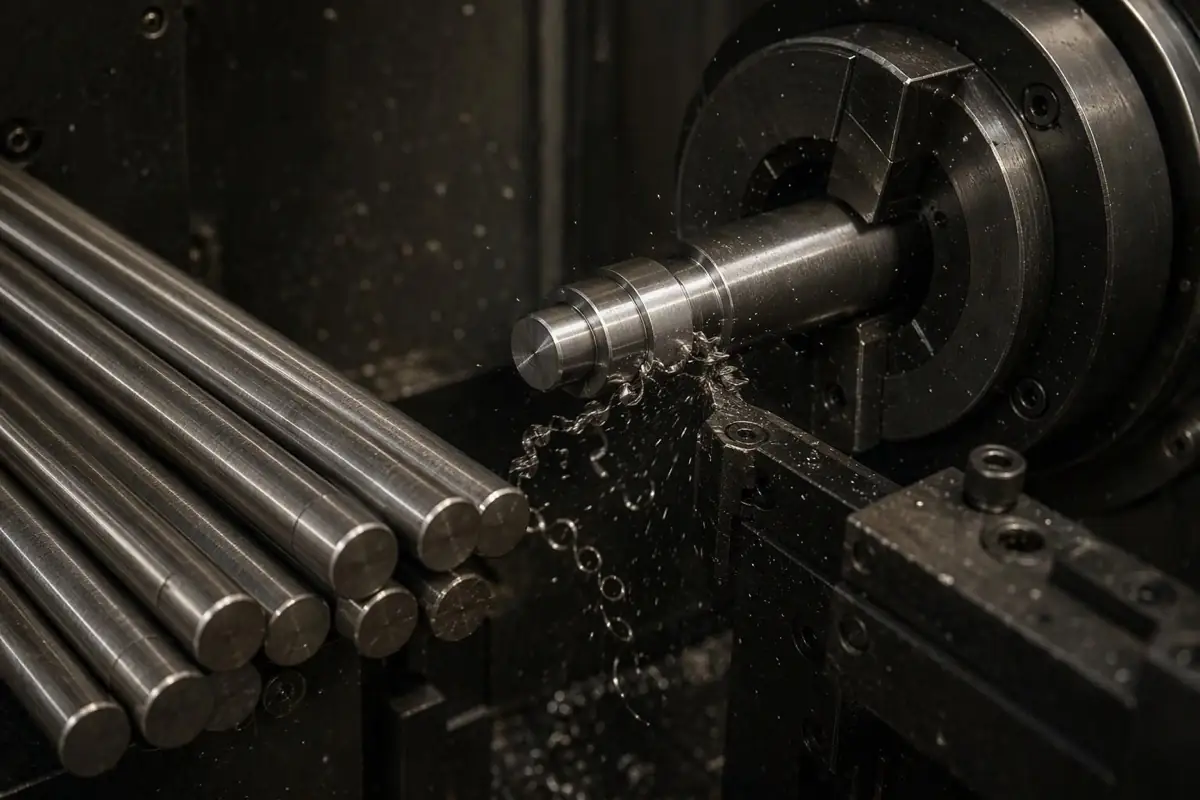
- Chip breaking: MnS inclusions, elongated during rolling, act as stress raisers in the shear zone. Instead of long, tangled ribbons, the chip breaks into short segments. On an automatic lathe this means chips do not wrap around the part or the tool.
- Lower friction: MnS forms a thin layer on the rake face of the tool, reducing friction and the formation of a built-up edge. The result is a better surface and longer tool life.
- Internal lubrication by lead: Lead does not dissolve in steel; it is dispersed as fine droplets. Because of its low melting point (about 327 °C) it softens in the cutting zone and acts like a lubricant. The effect is most noticeable at high cutting speeds.
This is also why manganese is kept high relative to sulphur: sulphur must be tied up as MnS rather than iron sulphide (FeS). FeS melts at low temperature and causes brittleness during hot working.
The benefit has a price. Elongated MnS inclusions reduce toughness and fatigue strength in the direction transverse to rolling. For this reason free-cutting steels are not used for welded, impact-loaded or safety-critical parts. We explain how inclusions are rated in our article on steel cleanliness, where we also note that the standard picture charts cannot be applied fully to free-cutting steels.
Three Groups, Three Uses
The table below links the groups in the composition table to part types. It is a selection summary; the final decision depends on the load case and the drawing.
| Group | Grades | Heat treatment | Typical part | Limit |
|---|---|---|---|---|
| Not intended for heat treatment | 11SMn30, 11SMn37 (+ leaded) | None; strength comes from cold drawing | Hydraulic and pneumatic fittings, nipples, bushings, low-load pins and screws | Not welded; not for impact or safety parts |
| Suitable for case hardening | 10S20, 15SMn13 (+ leaded) | Carburising, quenching, low-temperature tempering | Small pins, rollers and guide parts with a wear surface | Limited core strength; for high loads move to a case-hardening steel such as 16MnCr5 |
| Suitable for quenching and tempering | 35S20, 36SMn14, 38SMn28, 44SMn28, 46S20 (+ leaded) | Quenching and tempering (as bar or as part) | Series parts that need strength: studs, shafts, connectors, hydraulic bodies | High sulphur limits toughness; for safety parts choose C45 or 42CrMo4 |
In the quench-and-temper group the choice is mostly a balance of carbon and sulphur. 35S20 and 36SMn14 have lower carbon and lower sulphur; 38SMn28 and 44SMn28 raise sulphur to 0.24–0.33% and put machinability first; 46S20 gives the highest carbon. The closest US counterpart of 44SMn28 is AISI 1144, but the manganese ranges are not identical.
Leaded or High-Sulphur?
In lead-free grades, machinability is raised by increasing sulphur. 11SMn37 does this with more sulphur (0.34–0.40%) and manganese than 11SMn30. Leaded grades add internal lubrication at the same sulphur level.
The use of lead is regulated in the EU. The RoHS Directive grants an exemption for lead as an alloying element in steel for machining purposes up to 0.35% by weight, and the End-of-Life Vehicles (ELV) Directive contains a similar exemption. Because the scope and duration of these exemptions are reviewed from time to time, ask about the customer's lead policy before quoting parts for export. For a detailed comparison of leaded and lead-free free-cutting steel, see our article on leaded vs lead-free free-cutting steel.
Delivery Condition and Tolerance
Free-cutting steel is almost always machined from cold drawn (+C) bright bar; on a bar-fed lathe, the uniformity of the cross-section governs the stability of the setup. For the quench-and-temper grades, EN 10277 also defines the order of heat treatment and drawing: +C+QT (quenched and tempered after drawing) and +QT+C (drawn after quenching and tempering). For larger diameters, peeled (+SH) or hot-rolled (+AR) delivery is also possible.
For tolerance classes (h9–h11) and the differences between production routes, see our bright steel tolerance guide; for what the codes mean, see our delivery condition codes article. You can check a bar's ISO 286 deviations with the Tolerance Calculator and compare a certificate analysis with the standard ranges using the Chemical Composition tool.
Which One Should You Choose?
- High-volume fittings, nipples, bushings; no heat treatment: 11SMn30, or 11SMnPb30 if lead is allowed. For more aggressive machining, 11SMn37 or 11SMnPb37.
- Small part with a hard surface and a tough core: 10S20 or 15SMn13, followed by case hardening.
- Series part that needs strength: 35S20 or 36SMn14; if machinability comes first, 38SMn28 or 44SMn28.
- Welded, impact-loaded or safety part: not a free-cutting steel; use C45, 42CrMo4 or a case-hardening steel.
What to Write in the Specification
- Grade and standard: e.g.
11SMnPb30, EN 10277or44SMn28, EN ISO 683-4 - Delivery condition:
+C,+SH,+C+QTor+QT+C - Section, size and tolerance class: e.g.
Ø20 h9or hexagon across flats - Length: mill length or exact length
- Lead requirement: is leaded steel acceptable, is a RoHS declaration needed?
- Certificate: EN 10204 3.1; third-party inspection by SGS, Bureau Veritas or TÜV on request
Frequently Asked Questions
Can free-cutting steel be welded?
It is not recommended. High sulphur increases the risk of hot cracking in the weld metal. For welded parts, use low-sulphur steels such as C22E or S355J2.
What is the difference between 11SMn30 and 11SMn37?
11SMn37 contains more sulphur (0.34–0.40%) and manganese (1.00–1.50%). Its chip breaks more easily and machining rates can be higher; in return, its ductility and toughness are somewhat lower.
Can free-cutting steel be quenched and tempered?
Yes, but only the medium-carbon group. 35S20, 36SMn14, 38SMn28, 44SMn28 and 46S20 are suitable for quenching and tempering. Low-carbon grades such as 11SMn30 do not harden.
What is the equivalent of 44SMn28?
The closest US counterpart is AISI 1144. The two grades are close but not identical; for certified supply, the standard named in the order governs. For other equivalents, see the Steel Grade Equivalents tool.
Supply from Aktif Çelik
We supply leaded and lead-free free-cutting steels as cold drawn bright bar in round, hexagon and square sections, to the required tolerance class and with an EN 10204 3.1 inspection certificate. For grades other than 11SMn30 and 11SMnPb30 (11SMn37, 15SMn13, 44SMn28, etc.), send us the grade, size and delivery condition; we will confirm availability with the producers in our supply network. Quotations are sent within 24 hours; lead time and minimum quantity vary by product and are stated in the quote.
🔗 See also: Quality & Certificates · Steel Equivalence Tables
Detailed Technical Info & Quotation
Contact our expert team for detailed technical documents, application recommendations, and custom dimension quotes on this topic.