
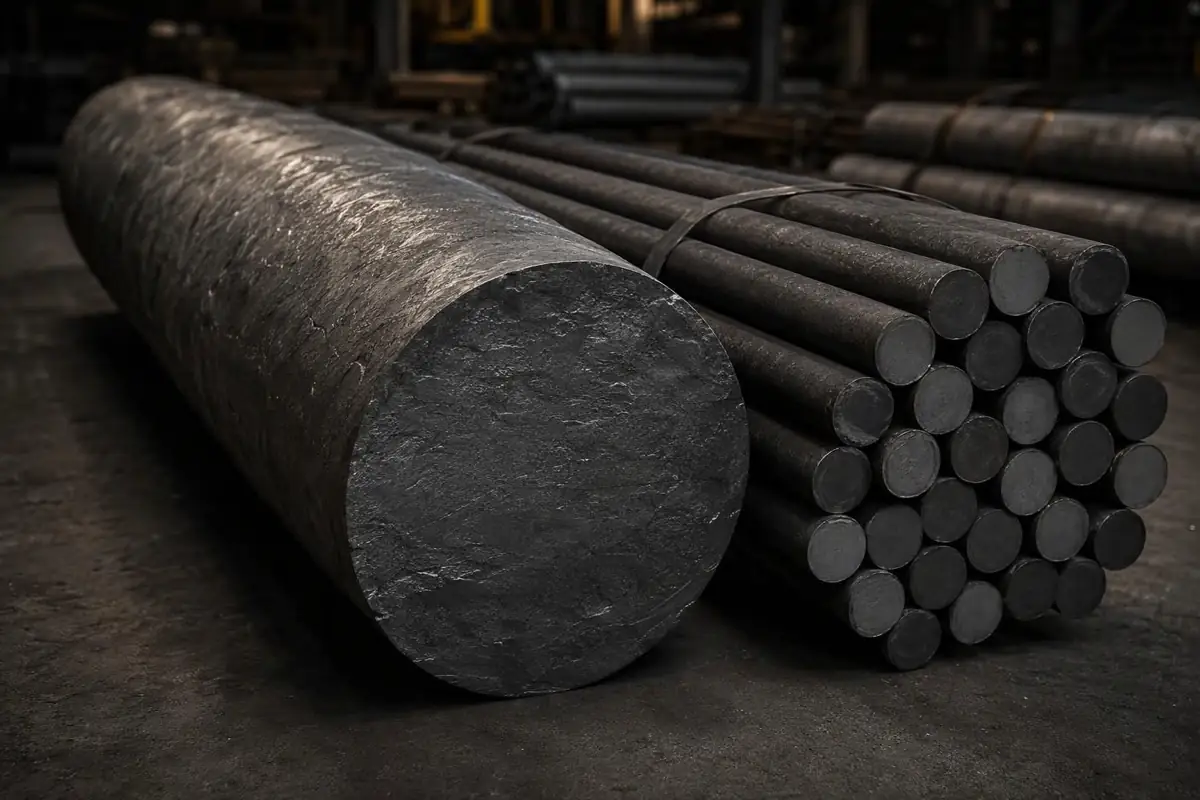
Forged vs Rolled Steel Bar: How to Choose
The same steel grade can be bought as rolled or as forged bar. The difference lies in the production route: reduction ratio, internal soundness, surface, tolerance and cost. We explain which route to choose for which diameter and part, with a worked example and a decision table.
📋 Product pages: Forged Bars → · Hot Rolled Bars → — process details: Forging · Hot Rolling
The Short Answer
The same steel grade — for example 42CrMo4 — can be supplied as hot rolled or as forged bar. The chemical composition is the same; what differs is the route by which the steel reached its final shape. Rolling passes a continuously cast billet or bloom through successive roll stands and reduces the section step by step. Open-die forging stretches an ingot or a large bloom by squeezing it under a press or hammer.
The practical rule: for standard diameters, series parts and tight tolerances, rolled bar is the more economical and faster choice. For large diameters, critical parts whose internal soundness must be proven by ultrasonic testing, and heavy dynamic loads, forged bar is preferred. In the diameter band in between, the decision is made on reduction ratio, inspection requirements and cost.
How the Two Processes Work
Hot rolling: The billet or bloom is heated in a reheating furnace, passed through roughing, intermediate and finishing stands, cooled on the cooling bed, straightened and cut to length. Dimensions and tolerances are defined by product standards: EN 10060 for rounds, EN 10058 for flats, EN 10059 for squares and EN 10061 for hexagons. The process is continuous and high-volume.
Open-die forging: The ingot or large bloom is heated to about 1100–1250 °C and progressively drawn out and rotated under the press. Forging is followed by normalising or quenching and tempering; the bar is usually rough turned and its internal soundness checked by ultrasonic testing. General delivery conditions for open-die forgings are found in the EN 10250 series. The process is piece by piece and can reach very large sections.
Reduction Ratio: Where the Difference Really Comes From
The reduction (forging) ratio is the cross-sectional area of the starting stock divided by that of the finished bar. It is this deformation that closes the voids of the cast structure, breaks up segregation and homogenises the core. For critical parts, specifications often demand a minimum reduction ratio; for forged bar the typical target is at least 3:1.
The table below is a worked example (not a real production plan) showing how the ratio falls as the bar diameter grows from a fixed starting section:
| Starting section | Area (mm²) | Bar diameter | Bar area (mm²) | Reduction ratio |
|---|---|---|---|---|
| 150 × 150 mm billet | 22,500 | Ø50 mm | 1,963 | 11.5 : 1 |
| 250 × 250 mm bloom | 62,500 | Ø120 mm | 11,310 | 5.5 : 1 |
| 400 × 400 mm bloom | 160,000 | Ø200 mm | 31,416 | 5.1 : 1 |
| 400 × 400 mm bloom | 160,000 | Ø300 mm | 70,686 | 2.3 : 1 |
| Ø800 mm ingot (mean section) | 502,655 | Ø400 mm | 125,664 | 4.0 : 1 |
The fourth row is the heart of the matter: rolling a Ø300 mm bar from the same bloom drops the ratio below 3:1. That is why large diameters need either a much bigger starting section or the forging route from a large ingot. In the product ranges on our site, hot rolled round bar runs up to 340 mm (EN 10060) and forged round bar from 200 to 1000 mm; the 200–340 mm band is the decision zone where both routes are possible.
Comparison Table
| Criterion | Hot rolled bar | Forged bar |
|---|---|---|
| Starting material | Continuously cast billet / bloom | Ingot or large bloom |
| Diameter range (on our product pages) | Rounds up to 340 mm (EN 10060) | Rounds 200–1000 mm |
| Dimensional tolerance | Tight, per the product standard tables | Wider; machining allowance is left |
| Surface | Mill scale; a decarburised surface layer is possible | Rougher; usually supplied rough turned |
| Internal soundness check | UT on request (e.g. EN 10308, SEP 1921) | UT is standard practice for critical work (e.g. EN 10228-3, SEP 1921) |
| Heat treatment condition | As rolled, +N, +A or +QT | Mostly +N or +QT |
| Cost | Series production; generally more economical | More labour and heat treatment per piece; generally more expensive |
| Typical use | General machine parts, shafts, bolt and forging stock | Large-diameter shafts, rotor and roll blanks, heavily loaded parts |
Mechanical Values: Is Forged Always Stronger?
No, not automatically. For the same grade, heat treatment and section, the minimum values in the standard do not change: the yield and tensile strength of 42CrMo4 in the +QT condition are defined by section band, and those bands are read the same way for rolled and forged bar. Values falling as the section grows is caused not by the production route but by the slower cooling of a large core; we explain this with tables in our Q&T Steels Guide.
The real contribution of forging shows up in three places:
- Core soundness in large sections: heavy press deformation penetrates to the middle of the section and closes casting voids. Reaching a sufficient reduction ratio in large diameters is hard by rolling.
- Transverse properties and homogeneity: a sufficient reduction ratio gives more balanced toughness and ductility across the section.
- Grain flow: when a part is forged close to its final shape (flanged shaft, gear blank), the fibres follow the geometry and help fatigue strength. In a straight bar the fibres run along the axis in both routes; this advantage only appears when the part is shaped afterwards.
For a quick comparison between hardness and tensile strength, use our Hardness Converter.
Which One to Choose? A Decision Guide
Choose rolled bar if:
- The diameter is within the rolling range and tolerance or machining allowance matters
- The part is made in series and cost is decisive
- The load is moderate, or the bar will be forged later (as forging stock)
Choose forged bar if:
- The diameter is above the rolling range
- The part is critical and internal soundness must be proven by ultrasonic testing
- Heavy dynamic loading, impact or a high safety factor is involved
- The customer specification calls for a forged product and a minimum reduction ratio
In the 200–340 mm band: check the specification first. If there is no UT acceptance class and no reduction-ratio requirement, rolled bar is often sufficient; if there is, forging is the safer route.
What to Write in the Specification
- Grade and standard — e.g. "42CrMo4, EN 10083-3".
- Production route — "hot rolled" or "forged"; for forged, the minimum reduction ratio.
- Heat treatment condition — +N, +A or +QT; for +QT, the target strength band.
- Surface condition — black (as rolled/as forged), rough turned or peeled.
- Ultrasonic testing — standard and acceptance class.
- Inspection document — EN 10204 3.1 (3.2 if independent inspection is required) and the location from which mechanical test pieces are taken.
To see the shipping weight in advance, use our Weight Calculator; for international equivalents of the grade, use Steel Grade Equivalents. If you are planning welded fabrication, our article Carbon Equivalent and Weldability helps you assess the need for preheating.
Frequently Asked Questions
Is forged bar stronger than rolled bar?
For the same grade, heat treatment and section, the minimum values in the standard are the same. The advantage of forging is core soundness and homogeneity in large sections, and grain flow in shaped parts.
Why is forged bar more expensive?
It is produced piece by piece; heating, press deformation, heat treatment, rough turning and ultrasonic testing take more labour and energy per unit.
Can rolled bar be ordered with ultrasonic testing?
Yes. UT can be requested for rolled bar too (e.g. EN 10308 or SEP 1921); the standard and acceptance class should be written in the order.
Supply from Aktif Çelik
We supply hot rolled and forged bars from the producers in our supply network, with an EN 10204 3.1 inspection certificate. Send us the grade, diameter, length, heat treatment condition, UT requirement and quantity; we will settle the production route against your specification together and send a written quotation. If you need a rough turned or peeled surface, see our bright steel options as well.
🔗 See also: How We Work · Quality & Certificates
Detailed Technical Info & Quotation
Contact our expert team for detailed technical documents, application recommendations, and custom dimension quotes on this topic.