Sourcing Steel from Turkey: Incoterms, Shipping Documents and EUR.1
When you buy steel from Turkey, three things must be settled up front: the right delivery term (Incoterm), a complete set of shipping documents and preferential origin (EUR.1 or A.TR). From the request for quotation to the inspection certificate, from FOB vs CIF to the EU regime for steel, here is what a buyer needs to know.
📋 This guide is written for purchasing teams preparing a request for quotation. On the technical side, use Steel Grade Equivalents → to check grades and equivalents and the Weight Calculator → for shipping weights.
The Short Answer
Smooth steel sourcing from Turkey is built in four steps: (1) a request for quotation that fully defines the material, (2) an Incoterms 2020 rule that fixes where risk and cost change hands, (3) the shipping documents customs and the bank will ask for, and (4) where available, a preferential origin document that brings a duty advantage (for the EU, mostly EUR.1 for steel products and A.TR for other industrial goods). This article explains what should be put in writing at each step. For information that changes by country and over time — duty rates, quotas, transit times — consult a current source and your customs broker.
1. Request for Quotation: The Precondition for a Fast, Accurate Answer
An incomplete request means emails going back and forth and a wrong price. A steel RFQ should contain these six items:
- Grade and standard — the EN, AISI, DIN, GOST or AFNOR name and the reference standard (e.g. "42CrMo4, EN 10083-3")
- Form and size — diameter, section, length, tolerance
- Delivery condition — rolled, cold drawn, forged; +A, +N, +QT
- Quantity — tonnes or pieces per item
- Inspection document and tests — EN 10204 3.1 or 3.2, additional tests (ultrasonic testing, impact test, etc.)
- Incoterm and place of delivery — the rule you want and the port or address
Sending your requirement list as Excel or PDF is enough. If an equivalent grade is acceptable, say so; you can find counterparts in other standards with our Steel Grade Equivalents tool.
2. Incoterms 2020: Where Do Risk and Cost Change Hands?
Incoterms are the delivery rules of the International Chamber of Commerce (ICC). They define what the price covers and at which point the risk of loss or damage passes to the buyer; they do not govern ownership or the method of payment. These are the rules we use in our quotations:
| Rule | Mode of transport | Point where risk passes to the buyer | Who pays main carriage? | Insurance obligation |
|---|---|---|---|---|
| EXW | Any | At the seller's premises, goods at the buyer's disposal | Buyer | None (risk with buyer) |
| FCA | Any | On handover to the buyer's carrier | Buyer | None (risk with buyer) |
| FOB | Sea | When loaded on board at the port of shipment | Buyer | None (risk with buyer) |
| CFR | Sea | When loaded on board at the port of shipment | Seller | None (risk with buyer) |
| CIF | Sea | When loaded on board at the port of shipment | Seller | Seller: at least ICC (C), 110% of invoice value |
| DAP | Any | At destination, ready for unloading | Seller | None (risk with seller) |
| DDP | Any | At destination, import cleared | Seller | None (risk with seller) |
Three practical lessons from the table:
- Under CFR and CIF the seller pays the freight, but the risk of the sea voyage is the buyer's. If you buy CFR, arrange the insurance yourself. The minimum ICC (C) cover under CIF is narrow; if you want wider cover, write it into the contract.
- Under EXW the buyer handles export clearance. If you have no agent in Turkey to run the export formalities, FCA is usually the more workable choice.
- For container cargo, the ICC recommends FCA, CPT or CIP instead of FOB/CFR/CIF, because a container is handed over at the terminal before it is loaded on the ship. Incoterms 2020 also provides that under FCA, on the buyer's instruction, the seller can be issued the "on board" bill of lading often required under a letter of credit.
The port of loading and the shipping line are stated at quotation stage. For example, there are regular container lines between Turkey and the Tunisian ports of Radès and Sfax, with a port-to-port time of roughly one week; on other routes the carrier's current schedule determines the transit time.
3. Shipping Documents: What Each One Is For
| Document | What it is for | Issued by |
|---|---|---|
| Commercial invoice | Customs value, description of goods, HS code, Incoterm | Seller |
| Weight list and packing list | Weight, size and heat number per bundle or crate | Seller |
| Bill of lading (B/L) or CMR | Contract of carriage; at sea the B/L also represents the goods | Carrier |
| Inspection document (EN 10204) | Conformity of the material with the ordered grade and standard | Producer; for 3.2 with the approval of an independent representative |
| Proof of origin | Origin of the goods; duty reduction where a preferential regime exists | General certificate of origin, A.TR or EUR.1 — endorsed by the competent authorities |
The first six digits of the HS code on the invoice are shared internationally under the Harmonized System; the final classification decision rests with your customs broker. Under a letter of credit, documents must comply strictly with the credit terms; a single discrepancy (weight, port name, grade spelling) delays payment. That is why it is good practice to share the L/C draft with the seller before it is opened.
4. Origin and Preferential Duty: EUR.1 or A.TR?
This is the most frequently confused topic, because there are two separate regimes in EU–Turkey trade:
- Customs Union (industrial goods): goods covered by the Customs Union move with an A.TR movement certificate, which shows that they are in free circulation.
- Coal and steel (ECSC) products: these products are outside the Customs Union. They are covered by the ECSC–Turkey free trade agreement signed in 1996; the rules of origin are set out in Protocol 1 of that agreement and are in line with the pan-European origin system. For these products, preferential origin is shown with proofs of origin such as the EUR.1.
Which product falls under which regime is determined by its HS code; in the same order, primary steel products and processed products (e.g. bars and flanges) may need different documents. We settle this item by item before the order.
One rule to remember: a EUR.1 is issued only for goods that meet the Turkish preferential rules of origin. A traded product of third-country origin, or a product that does not satisfy the origin rule, may fall outside its scope. Outside the EU the picture depends on the agreement: for example, under the Turkey–Tunisia free trade agreement a EUR.1 can be issued for eligible products; where no preferential agreement applies to the destination country, a general (non-preferential) certificate of origin is used instead. The up-to-date list of Turkey's agreements in force is published on the website of the Turkish Ministry of Trade.
Carbon rules for imports into the EU: the EU's Carbon Border Adjustment Mechanism (CBAM) covers iron and steel products. The importer in the EU is obliged to declare the embedded emissions of the goods it imports and requests that data from the supply chain. If you are buying steel for the EU, state your emissions data needs at quotation stage.
5. Inspection and Quality Documents
EN 10204 defines the types of material inspection documents:
- 2.1 — Declaration of compliance with the order (no test results)
- 2.2 — Test report (based on non-specific inspection)
- 3.1 — Inspection certificate, validated by the manufacturer's inspection representative, who is independent of the manufacturing department
- 3.2 — Certificate validated jointly by the manufacturer's inspection representative and the purchaser's representative or an inspector designated by official regulations
For steel bar and flange orders, 3.1 is the most common request. If independent supervision is required, a 3.2 certificate or third-party inspection is arranged on request; since this affects cost and schedule, state it at RFQ stage. To compare a chemical analysis with the certificate values, use our Chemical Composition tool; if you will weld, our article Carbon Equivalent and Weldability helps you assess the carbon equivalent.
6. Packing and Marking
In overseas shipments, packing matters as much as the quality of the material. Typical measures you can request:
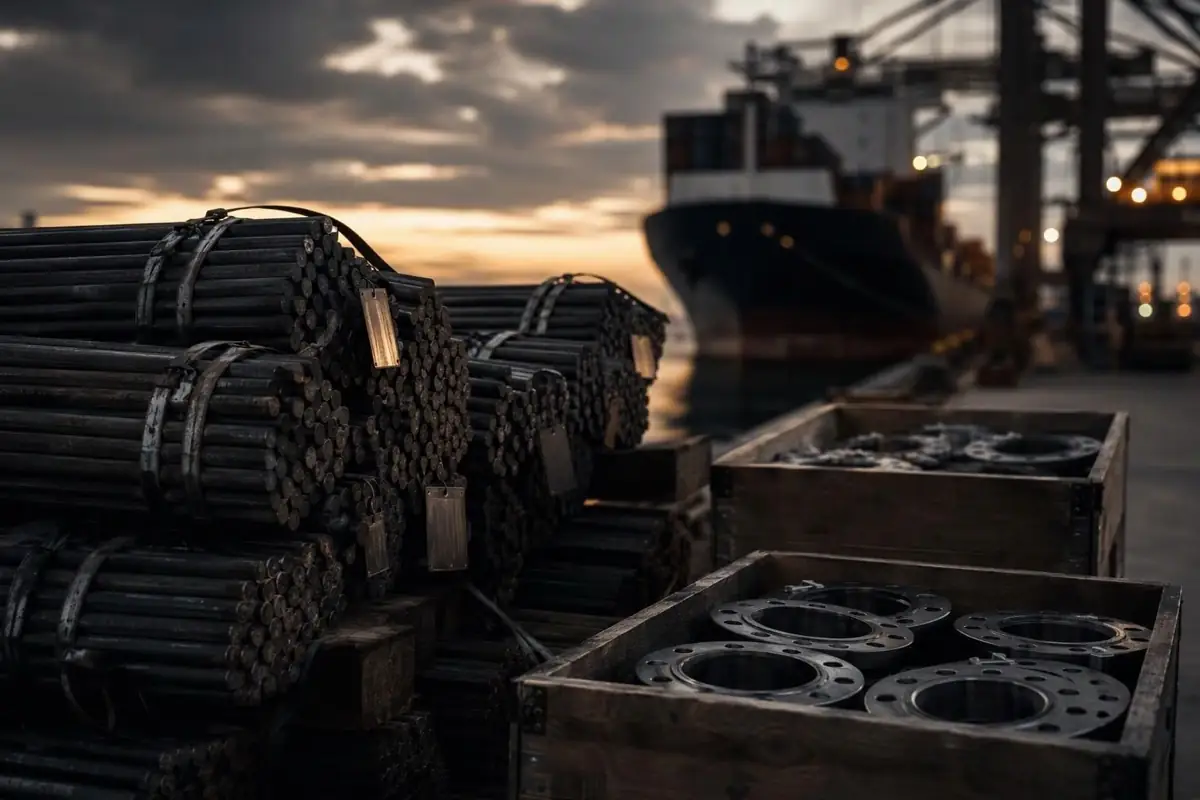
- Seaworthy wooden crates or steel pallets (for machined products such as flanges and fittings)
- Moisture barrier and anti-corrosion coating (especially on machined surfaces)
- A label per bundle with heat number traceability — the number on the label must match the number on the certificate
For more on packing and logistics, see our Packaging & Logistics page.
7. Quotation and Payment Terms
Our quotation states the price, delivery time, Incoterm and payment terms in writing. The two most common payment methods in international steel trade are advance or part-advance bank transfer (T/T) and the letter of credit (L/C); letters of credit are subject to the ICC's UCP 600 rules. Which route fits is set in the quotation according to order value, country and the business relationship.
Frequently Asked Questions
Can a EUR.1 be obtained for every steel product?
No. A EUR.1 is issued only for products that meet the rules of origin of the relevant agreement. A traded product of third-country origin, or one that does not satisfy the rule, may fall outside the scope; this should be checked product by product before the order.
Is the insurance in a CIF price enough?
Under CIF the seller's obligation is minimum cover: ICC (C) terms, 110% of the invoice value. If you want broader cover (e.g. ICC (A)), write it explicitly into the contract, or buy CFR and insure the cargo yourself.
Which Incoterm should I choose?
If you have your own freight contract and a forwarder in Turkey, FCA or FOB; if you want the seller to organise the freight, CFR or CIF; if you want delivery to your door, DAP. DDP is hard to apply in many countries because the seller takes on the import duties.
Working with Aktif Çelik
Aktif Çelik is a steel supply and export company based in Istanbul; production takes place at partner plants. We are responsible for choosing the grade and the producer, for conformity with your specification, for the inspection document and for following the shipment through. We can combine different product groups — hot rolled bars, forged bars and flanges — in one order and prepare their documents in one place. Send us your requirement list; our team responds within 24 hours.
🔗 See also: How We Work · Quality & Certificates · Export Markets · Buyer FAQ
Detailed Technical Info & Quotation
Contact our expert team for detailed technical documents, application recommendations, and custom dimension quotes on this topic.