
Bright Steel / PL
Peeling
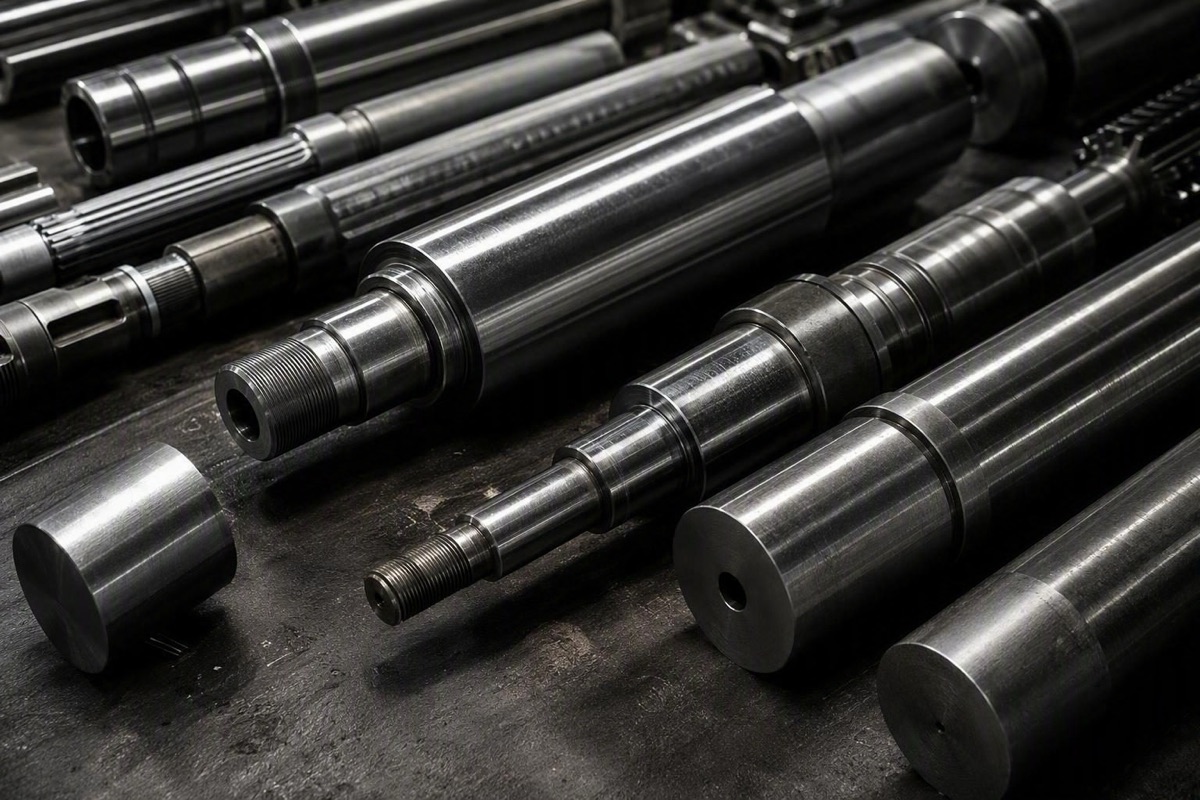
Peeling is the process of removing material from the surface of hot-rolled bars to eliminate the decarburized layer and surface defects. It is preferred especially for larger diameters (15-160mm) and provides a smoother surface than cold drawing.
Technical Specifications
Key Features
- Complete removal of decarburized layer
- Elimination of surface cracks and defects
- Precise dimensional tolerance (h9/h10/h11)
- Economical solution for large diameters (80mm+)
- Homogeneous and smooth surface structure
- Suitable for use after heat treatment
- Dimensional accuracy for direct CNC machine feeding
- Metallurgically clean surface
- Surface quality suitable for ultrasonic testing
- Low waste - high efficiency
Applications
- Large diameter shaft and axle production
- Hydraulic piston rod manufacturing
- Crankshafts and eccentric shafts
- Heavy industry machine parts
- Gearbox shafts
- Energy sector (turbine shafts)
- Defense industry components
- Structural elements requiring high strength
Dimension Table
| Profile | Size Range (mm) | Tolerance | Standard | Surface (Ra) |
|---|---|---|---|---|
| Round | 15 - 30 | h9 | EN 10278 | ≤ 1.6 µm |
| Round | 30 - 50 | h9 | EN 10278 | ≤ 2.0 µm |
| Round | 50 - 80 | h9/h10 | EN 10278 | ≤ 2.5 µm |
| Round | 80 - 100 | h11 | EN 10278 | ≤ 3.2 µm |
| Round | 100 - 130 | h11 | EN 10278 | ≤ 3.2 µm |
| Round | 130 - 160 | h11 | EN 10278 | ≤ 4.0 µm |
Technical Notes
- 01Standard tolerance for diameters above 80mm is h11.
- 02Peeling depth is typically 1-3mm.
- 03Post-process straightness is within 1mm/m.
- 04Internal structure inspection possible with ultrasonic testing.
- 05Standard length: 3000-7000mm, custom cutting available on request.
- 06Peeling + straightening combination provides optimum results.
- 07Ideal for alloy steels like 42CrMo4, 34CrMo4.
Steel Grades
Other Types
What is bright steel?
Bright steel is hot-rolled bar finished cold — by cold drawing, peeling/turning or grinding — to a precise size and clean surface. Typical tolerances: h9/h11 for cold drawn, h6–h9 for ground bar (ISO 286). With its scale-free bright surface, tight tolerance and straightness, it often needs no further machining (EN 10277).
Cold drawing vs peeling vs grinding
Cold drawing: the bar is pulled through a die; strain hardening raises yield strength by ~10–20% and gives h9/h11 tolerance — the most economical bright product. Peeling (turning): the surface layer is machined off, removing surface cracks and decarburization without adding residual stress — ideal for large diameters and Q&T grades. Grinding: the tightest tolerance (h6–h9) and the best finish (Ra ≤ 0.8 µm) — for shafts and pins. Typical grades: C45, 42CrMo4, 11SMn30, 16MnCr5.
Frequently Asked Questions
Bright steel vs hot rolled — what is the difference?+
Bright steel is cold finished: scale-free surface, h6–h11 tolerance and high straightness; hot rolled has scale and wide tolerances and is usually bought for further machining.
Does cold drawing increase strength?+
Yes; strain hardening typically raises yield strength by 10–20%, with slightly reduced ductility. Stress-relief annealing is applied where needed.
When is peeled (turned) bar preferred?+
For large diameters, quenched-and-tempered grades, and when surface defects/decarburization must be fully removed — it gives a clean surface without adding residual stress.
Which tolerances are standard for bright steel?+
h9 or h11 for cold drawn, h6–h9 for ground bar (ISO 286-2, EN 10277).
Related Blog Posts
Technical articles, guides and industry analyses
C45 vs 42CrMo4 Steel: Carbon or Alloy — Which to Choose?
We compare C45 (1045) carbon steel with 42CrMo4 (4140) chrome-moly quenched & tempered steel by hardenability, strength, welding and cost — which to choose and when?
Quenched and Tempered Steels: EN 10083 Grades, Values and How to Choose
Quenched and tempered (Q&T) steel is the class that delivers strength and toughness together. We put the six main EN 10083 grades — C45, 25CrMo4, 42CrMo4, 39NiCrMo3, 34CrNiMo6, 51CrV4 — into one table with chemistry, section-dependent values and selection criteria.