Olet Selection: Weldolet, Sockolet, Threadolet and MSS SP-97
An olet is a forged fitting that takes a reinforced branch off a run pipe without a tee. We explain the difference between weldolet, sockolet and threadolet, how they compare with a tee and a stub-in, how size and wall/class are defined under MSS SP-97, material matching, and what to write on the order.
🔩 Products: Olet branch fittings · Weldolet · Sockolet · Threadolet
Short Answer
An olet is an integrally reinforced forged fitting that is welded onto the run pipe to provide a branch outlet. Its dimensions and design basis are in MSS SP-97. The type is chosen by how the branch pipe will be connected: weldolet for a butt weld, sockolet for a socket weld, threadolet for a threaded connection. Four pieces of information go on the order together: run size × branch size, the branch wall thickness (weldolet) or class (sockolet, threadolet), a material that is weld-compatible with the run pipe, and the standard. If any of these is missing, the part either will not sit on the curvature of the run pipe or will not match the branch pipe.
Why Olets Exist: Tee, Stub-in and Olet
There are three ways to take a branch off a main line, and each has its place:
- Tee (ASME B16.9): The run is cut, the tee goes into the line with two butt welds, and the branch is joined with a third. It is the standard solution for equal branches and branches close to the run size.
- Stub-in: The branch pipe is welded directly onto the run pipe. Because the hole weakens the run pipe's cross-section, the piping code (ASME B31.3, area replacement calculation) often requires a reinforcing pad.
- Olet: The run is not cut. The olet sits over the hole cut in the run pipe with a single weld and replaces the material removed by the hole with its own body, so no separate reinforcing pad is needed.
Which one to use for a given size combination is not arbitrary. The branch table in the project's material specification (piping class) defines the connection for each run × branch size. Olets are preferred where the branch is clearly smaller than the run.
Branch Connection Options Compared
| Option | Branch end | Typical use | Weld to run | Reinforcement | Note |
|---|---|---|---|---|---|
| Equal / reducing tee | Butt weld | Equal or near-equal branch | Run is cut, 2 welds | In the body | Longer installation time because the run is cut |
| Weldolet | Butt weld | Small and medium branches | Single weld, run not cut | Integral | Ordered by branch wall thickness |
| Sockolet | Socket weld | Small branches, instruments, drains | Single weld | Integral | Ordered by class |
| Threadolet | Threaded (NPT) | Small branches, instrument connections | Single weld | Integral | Check that threaded joints are allowed for the service |
| Sweepolet | Butt weld | Lines sensitive to flow and fatigue | Contoured to the run, smooth transition | Integral | Large-radius transition, inspectable weld |
| Stub-in + pad | Butt/fillet weld | Low-risk lines where the code permits | Branch + pad welds | Via pad | Area replacement calculation required |
Compiled from the connection types in ASME B16.9, MSS SP-97 and ASME B31.3. Final selection follows the project's branch table.
Olet Types
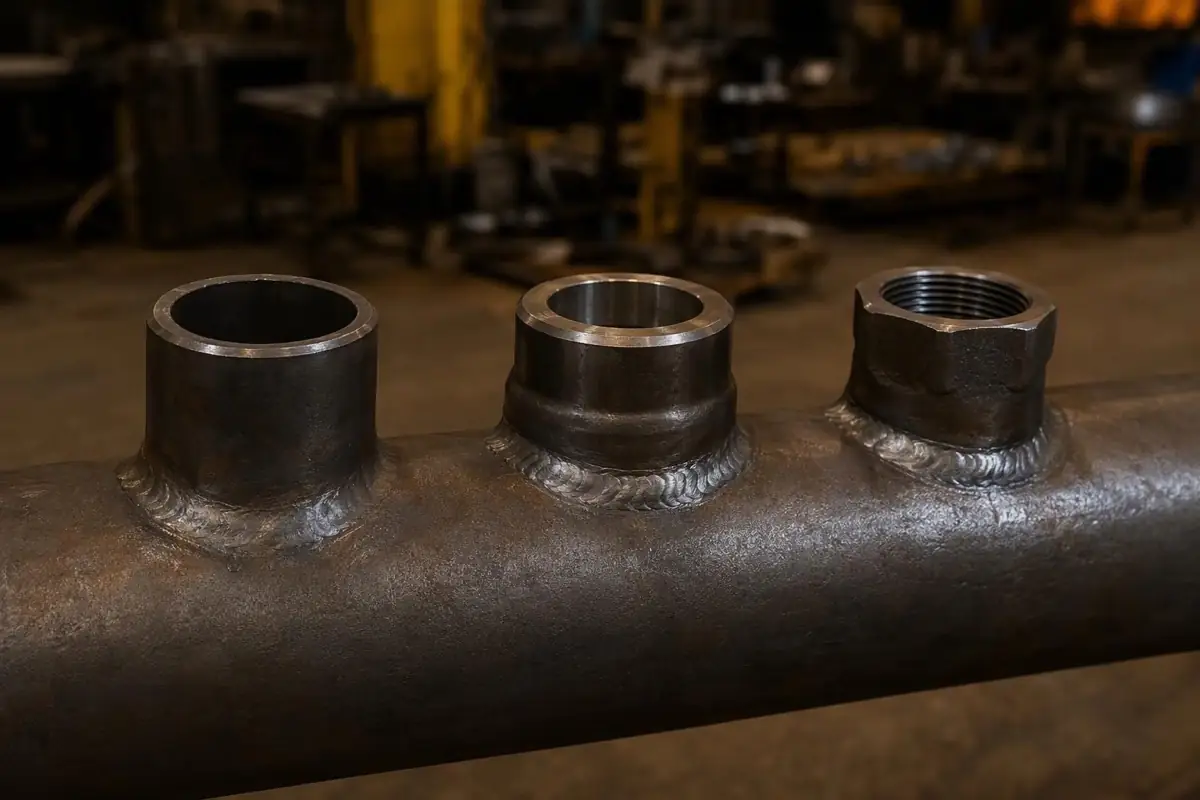
- Weldolet: Butt-weld branch. The most common type. The branch end comes bevelled and is ordered by the branch pipe's wall thickness.
- Sockolet: Socket-weld branch. Used for small-bore pipes, drain and vent connections.
- Threadolet: Threaded (NPT) branch. Used for pressure gauges, thermowells and sampling connections.
- Elbolet and latrolet: For branching off the back of an elbow and at a 45° angle.
- Nipolet: One-piece outlet with an extended, nipple-type body; usually for valve connections.
- Sweepolet and insert weldolet: For larger branch ratios and lines where easy weld inspection is wanted.
How Is the Size Defined?
The underside of an olet is contoured to the outside diameter of the run pipe. So the run size is part of the order; the branch size alone is not enough. The correct format is Weldolet, run NPS 8 × branch NPS 2. Manufacturers make bodies that fit a certain range of run sizes for a given branch size. If run and branch are the same size (size-on-size), that must be stated separately.
Wall thickness and class:
- Weldolets are ordered by the branch pipe's wall designation: STD, XS, SCH 160 or XXS. The wall at the weld bevel must match the branch pipe.
- Sockolets and threadolets are defined by class (e.g. 3000 and 6000). Which class corresponds to which branch pipe wall thickness is given in MSS SP-97's own table.
There is a trap here. The threaded fitting matching in ASME B16.11 (for example threaded Class 3000 = SCH 160 pipe) should not be carried over to olets directly. SP-97 and B16.11 tables are built differently. Check the branch pipe wall against the SP-97 table and the manufacturer's rating statement. For the B16.11 matching, see our schedule matching guide; for schedule wall thicknesses, use the DN-NPS tool.
Material: Weld Compatibility with the Run Pipe
Because the olet is welded to the run pipe, its material is chosen from the run pipe's material family:
| Run pipe | Olet material (forged) |
|---|---|
| Carbon steel (A106 Gr. B) | ASTM A105 / A105N |
| Low temperature (A333 Gr. 6) | ASTM A350 LF2 |
| Cr-Mo (A335 P11 / P22) | ASTM A182 F11 / F22 |
| Stainless (A312 TP304L / TP316L) | ASTM A182 F304L / F316L |
Matching follows the material families of the ASTM product standards.
A105N is a common order-specific designation for A105 supplied in the normalized condition. Many oil and gas specifications require this heat treatment condition for forged carbon steel parts. For the European counterpart of the carbon steel forging material, see the A105 vs P250GH comparison; for grade selection in stainless olets, see the 316L datasheet. The fitting material side of Cr-Mo lines is covered in our A234 WPB, WP11 and WP22 comparison.
Welding and Inspection
- Hole: The hole cut in the run pipe must match the olet's bore. Slag and icicles left inside after welding must be removed, otherwise the flow area is reduced.
- Weld: The olet-to-run weld follows the weld detail the code defines for branch connections. A butt-weld branch end is suitable for radiography. Fillet welds at socket and threaded ends are usually checked with surface methods (MT/PT).
- Listed component: ASME B31.3 includes MSS SP-97 among its listed component standards. A compliant, marked olet can be used without separate proof of strength in the design. If an unlisted design is used, its strength must be qualified separately by the code's methods.
Which One to Choose?
- If the branch is butt-welded and radiography is required: weldolet.
- If the branch is small-bore on a socket-weld line: sockolet; choose the class from the SP-97 table according to the branch pipe.
- If a breakable end is needed, such as an instrument connection: threadolet; check in the piping class whether threaded joints are permitted for that service.
- If you need a branch on an elbow or at an angle: elbolet or latrolet.
- If the branch is equal or very close to the run size: a tee instead of an olet; a sweepolet if fatigue or flow is critical.
What to Write in the Specification
- Type: weldolet / sockolet / threadolet / elbolet …
- Size:
run NPS 8 × branch NPS 2 - Wall or class:
branch SCH 160for a weldolet;Class 6000for sockolets and threadolets - Material:
ASTM A105N(according to the run pipe) - Standard and ends: MSS SP-97; weld bevel to ASME B16.25, threaded end to ASME B1.20.1 (NPT)
- Documents: EN 10204 3.1; third-party inspection by SGS, Bureau Veritas or TÜV if required
Full example: Weldolet, run NPS 8 × branch NPS 2, branch SCH 160, ASTM A105N, MSS SP-97, BW ends ASME B16.25, EN 10204 3.1.
Frequently Asked Questions
What is the difference between a weldolet and a tee?
A tee goes into the line: the run is cut and joined with two butt welds. A weldolet sits on top of the run pipe with a single weld and the run is not cut. For small branches, a weldolet means fewer welds and shorter installation. For equal branches, the tee is standard.
Should a sockolet be Class 3000 or 6000?
It depends on the branch pipe's wall thickness. The matching is given in the MSS SP-97 table. Do not apply the B16.11 fitting matching directly to olets; write the branch pipe schedule and confirm the class against the SP-97 table.
Should the olet material be the same as the run pipe?
It should be from the same material family and weld-compatible. A105 is used on carbon steel pipe, A350 LF2 on low-temperature pipe, A182 F11 or F22 on Cr-Mo pipe, and A182 F304L or F316L on stainless pipe.
Does an olet fit any run pipe diameter?
No. The base of the olet is contoured to the outside diameter of the run pipe, so the run size must be written on the order. Manufacturers make bodies that fit certain run size ranges for a given branch size.
Sourcing from Aktif Çelik
We supply weldolets, sockolets, threadolets and other olet types in A105/A105N, A350 LF2, A182 Cr-Mo and stainless grades, together with matching tee and fitting items, with an EN 10204 3.1 inspection certificate. In your material list, write the run × branch size and the wall thickness or class for each olet; we will confirm compatibility with the manufacturers in our supply network. Quotes are sent within 24 hours; lead time and minimum quantity vary by product and are stated in the quote.
🔗 See also: Quality & Certificates · Pressure Class tool
Detailed Technical Info & Quotation
Contact our expert team for detailed technical documents, application recommendations, and custom dimension quotes on this topic.