
Round Steel Bar
Cold-drawn round steel commonly used in shafts, machine parts, and fasteners.
Round Steel Bar
Cold-drawn round steel commonly used in shafts, machine parts, and fasteners.
Available Types
Technical Specifications
Key Features
- High surface quality
- Tight dimensional tolerance
- High strength and toughness
- Excellent machinability
- Good weldability
- Available in standard and custom sizes
Applications
- Shaft and axle production
- Fasteners and bolts
- Machine manufacturing
- Structural components
- Automotive parts
- Industrial equipment
Dimension Table
| Diameter (mm) | Tolerance | Length (mm) | Weight (kg) |
|---|---|---|---|
| 10 mm | h9: 0 / -0.036 mm | 6 m | 0.62 kg/m |
| 20 mm | h9: 0 / -0.052 mm | 6 m | 2.47 kg/m |
| 40 mm | h9: 0 / -0.062 mm | 6 m | 9.87 kg/m |
| 80 mm | h9: 0 / -0.074 mm | 6 m | 39.5 kg/m |
Technical Notes
- 01Cold-drawing improves surface finish and dimensional accuracy.
- 02Available in carburized or quenched grades.
- 03Use C45 or 1040 grade for high-strength applications.
Cold-drawn round bar: stock for shafts, pins and automatic lathes
Cold-drawn round bar is the most widely used section in this family. It provides ready-to-size stock for shafts, axles, pins, bushes, bolt and stud blanks, and parts machined directly on automatic lathes. On a round section the diameter tolerance is measured around the circumference, and ovality must also stay within the tolerance band, which makes the bar especially suitable for parts that are centred and rotated in a chuck or collet.
Technical delivery conditions are given in EN 10277:2018 by steel group: non-alloy steels for general engineering, free-cutting steels, case-hardening steels and quenched-and-tempered steels (formerly parts 2–5 of EN 10277). Dimensional and shape tolerances are in EN 10278; for rounds the standard class is h9, with h10 and h11 also available. EN 10277 also defines surface quality classes, and in the higher classes freedom from cracks is verified by eddy-current testing. For purchases to US standards the equivalent is ASTM A108, with grades such as 1018, 1045 and 12L14.
Drawing leaves residual stresses in the bar, so a part can bow when a keyway or flat is machined on one side; for precision parts, ask for stress-relieved bar. Bearing and seal seats with h6 or h7 fits cannot be reached by drawing tolerances alone: machine those zones or start from ground bar. In the order, state the grade, diameter, tolerance class, length and, where needed, straightening and heat-treatment condition.
Related products
What is cold drawn steel?
Cold drawn steel is made by pulling descaled hot-rolled bar through a die at room temperature.
Cold Drawn Bars: guide and FAQRelated Blog Posts
Technical articles, guides and industry analyses
Free-Cutting Steel Grades: Choosing from 11SMn30 to 44SMn28
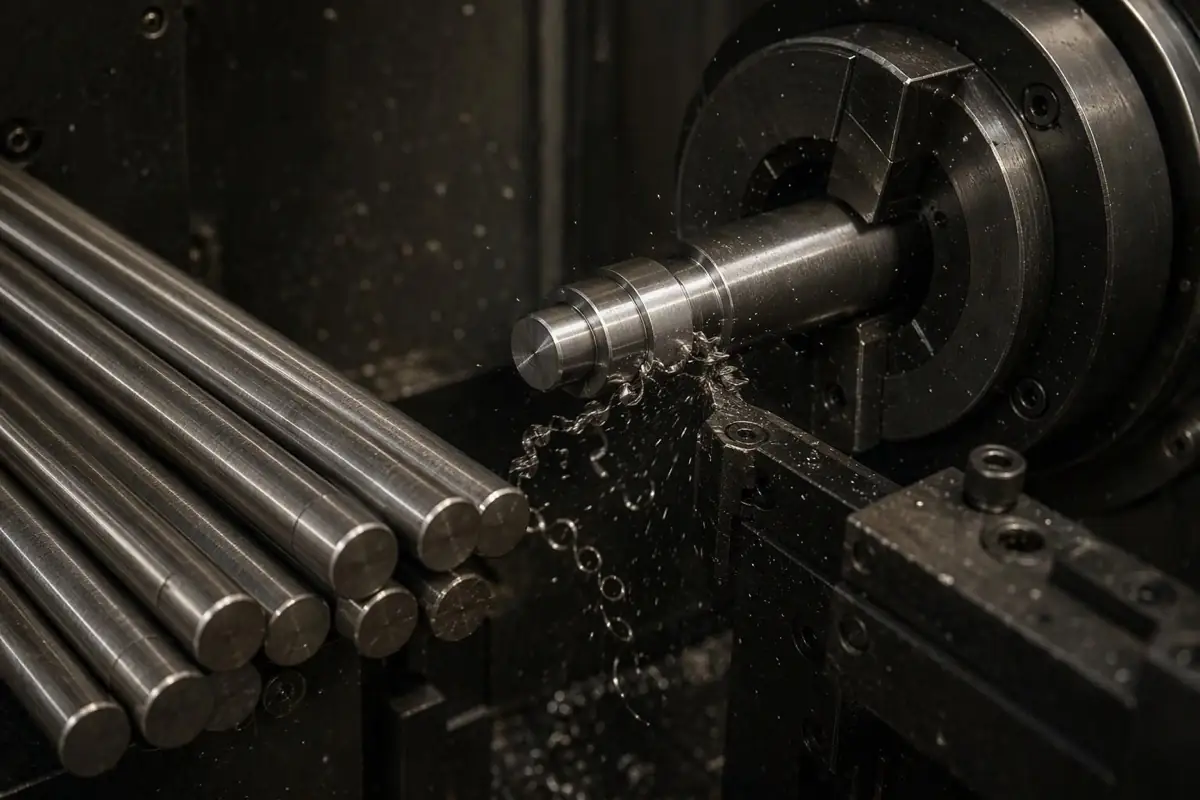
Free-cutting steel is more than 11SMn30 and 11SMnPb30. EN ISO 683-4 (formerly EN 10087) splits these steels into three groups: not intended for heat treatment, suitable for case hardening and suitable for quenching and tempering. Chemistry table, how machinability works and which grade suits which part.
h9, h10, h11 Tolerances for Bright Steel Bars: How to Choose
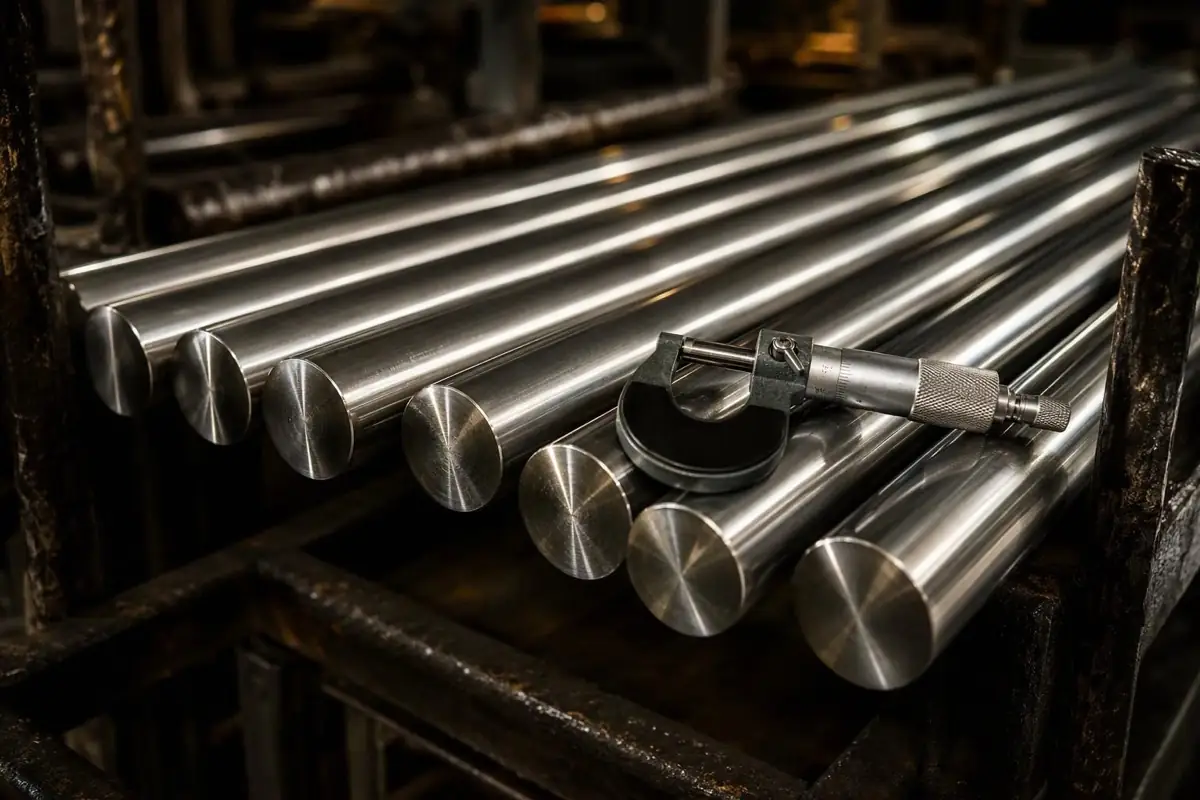
For bright bars, h9, h10 and h11 are ISO 286 shaft tolerance classes: the upper deviation is zero and the lower deviation is negative, depending on diameter. We explain which production route gives which tolerance, what the difference between h9 and h11 means in microns, and what else must be written on the order next to the tolerance.