
Flat Steel Bar
Precision flat steel bar with smooth surface and tight tolerance, widely used in construction, machinery, and industrial manufacturing.
Flat Steel Bar
Precision flat steel bar with smooth surface and tight tolerance, widely used in construction, machinery, and industrial manufacturing.
Available Types
Technical Specifications
Key Features
- High surface finish
- Sharp edges and uniform thickness tolerance
- Good machinability
- High strength and durability
- Suitable for welding and coating
- Available in standard and custom dimensions
Applications
- Tooling and fixture manufacturing
- Steel structures and frameworks
- Machine components
- Automotive chassis and fittings
- Industrial machinery
- Furniture and assembly systems
Dimension Table
| Size | Length (mm) | Weight (kg) |
|---|---|---|
| 20x5 mm | 6 m | 0.785 kg/m |
| 40x10 mm | 6 m | 3.14 kg/m |
| 80x20 mm | 6 m | 12.56 kg/m |
| 100x30 mm | 6 m | 23.55 kg/m |
Technical Notes
- 01Cold-drawn flats provide improved dimensional accuracy and reduced surface roughness.
- 02C45 or 1040 grade recommended for high-strength applications.
- 03Typically supplied in 6-meter lengths; custom cutting available on request.
Cold-drawn flat bar: base plates, gibs, spacers and fixtures
Cold-drawn flat bar provides a rectangular section with controlled width and thickness, flat faces and defined edges, ready for parts that would otherwise be milled from plate: machine bases and mounting plates, gibs and wear strips, spacers and shims, vice jaws, jig and fixture elements, levers and brackets, and conveyor and packaging-machine parts. Drawing leaves a smooth, scale-free surface that can be painted, plated or welded directly.
Width and thickness tolerances for drawn flats are set in EN 10278, usually in class h11, and the standard also limits edge radius, flatness and edge straightness (camber). Very wide, thin sections are difficult to draw and are often made by cold rolling or by milling from plate instead, so check that the required width-to-thickness ratio is available. Grades: S235JRC+C and S355J2C+C to EN 10277 for welded fabrications, C45+C where strength or induction hardening is needed, 16MnCr5+C for case-hardened wear parts, and 11SMn30+C for heavily machined parts.
When one face is machined, a flat bar distorts more than a round because the drawing stresses are released unevenly; for precision plates, machine both faces symmetrically or start from stress-relieved material. Specify width × thickness, tolerance class, edge form (sharp or rounded), length and grade. For rough fabrication, hot-rolled flat is more economical; for keys, use key steel.
Related products
What is cold drawn steel?
Cold drawn steel is made by pulling descaled hot-rolled bar through a die at room temperature.
Cold Drawn Bars: guide and FAQRelated Blog Posts
Technical articles, guides and industry analyses
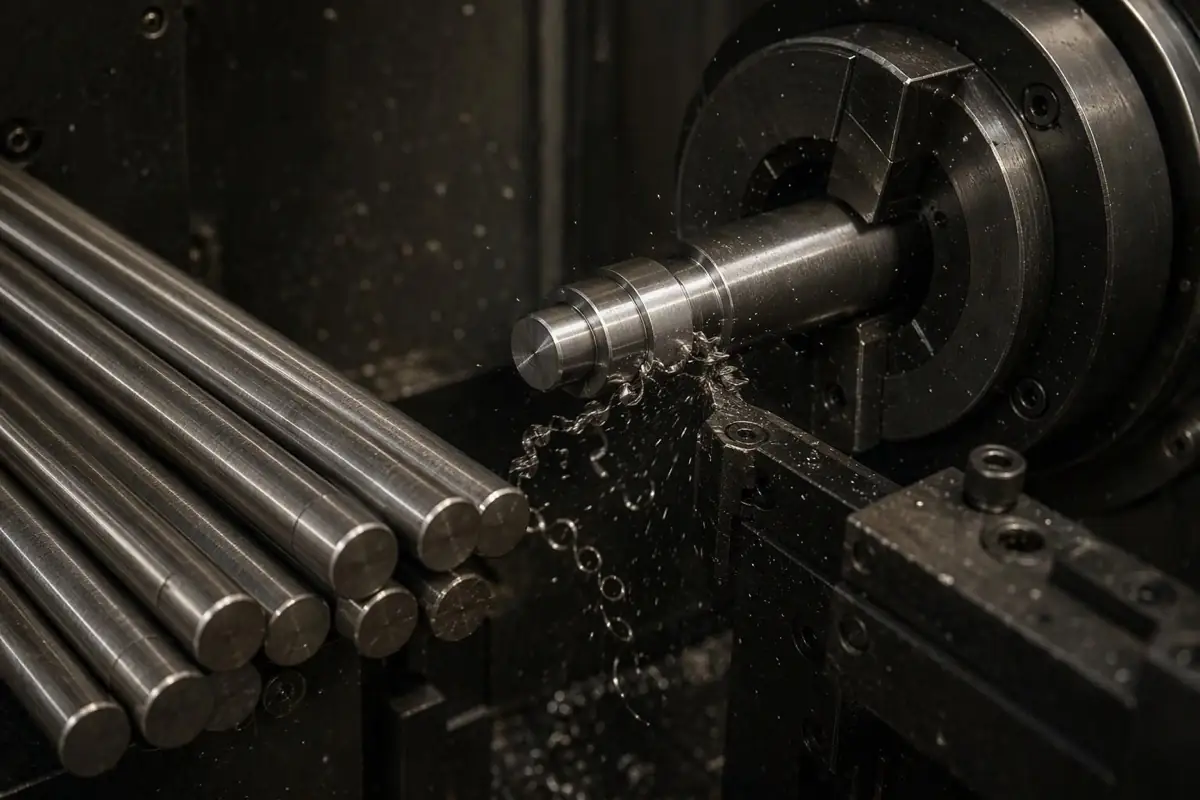
Free-Cutting Steel Grades: Choosing from 11SMn30 to 44SMn28
Free-cutting steel is more than 11SMn30 and 11SMnPb30. EN ISO 683-4 (formerly EN 10087) splits these steels into three groups: not intended for heat treatment, suitable for case hardening and suitable for quenching and tempering. Chemistry table, how machinability works and which grade suits which part.
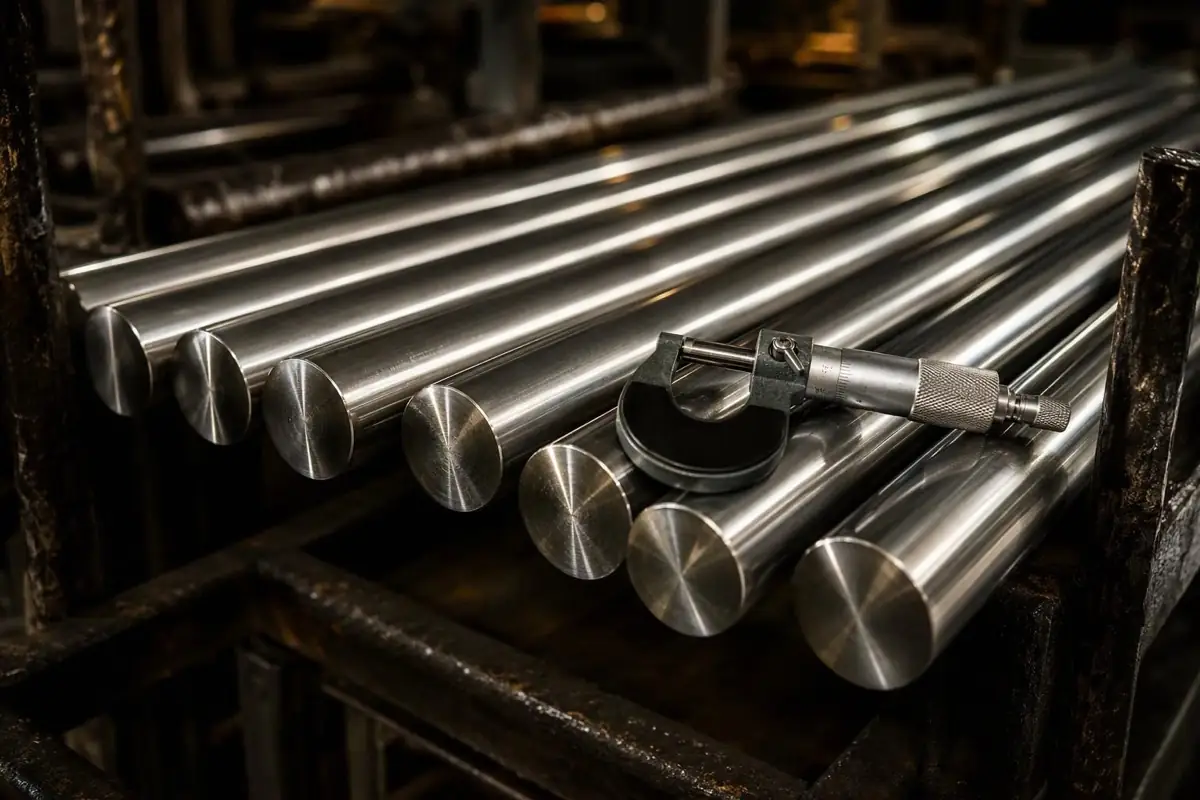
h9, h10, h11 Tolerances for Bright Steel Bars: How to Choose
For bright bars, h9, h10 and h11 are ISO 286 shaft tolerance classes: the upper deviation is zero and the lower deviation is negative, depending on diameter. We explain which production route gives which tolerance, what the difference between h9 and h11 means in microns, and what else must be written on the order next to the tolerance.