
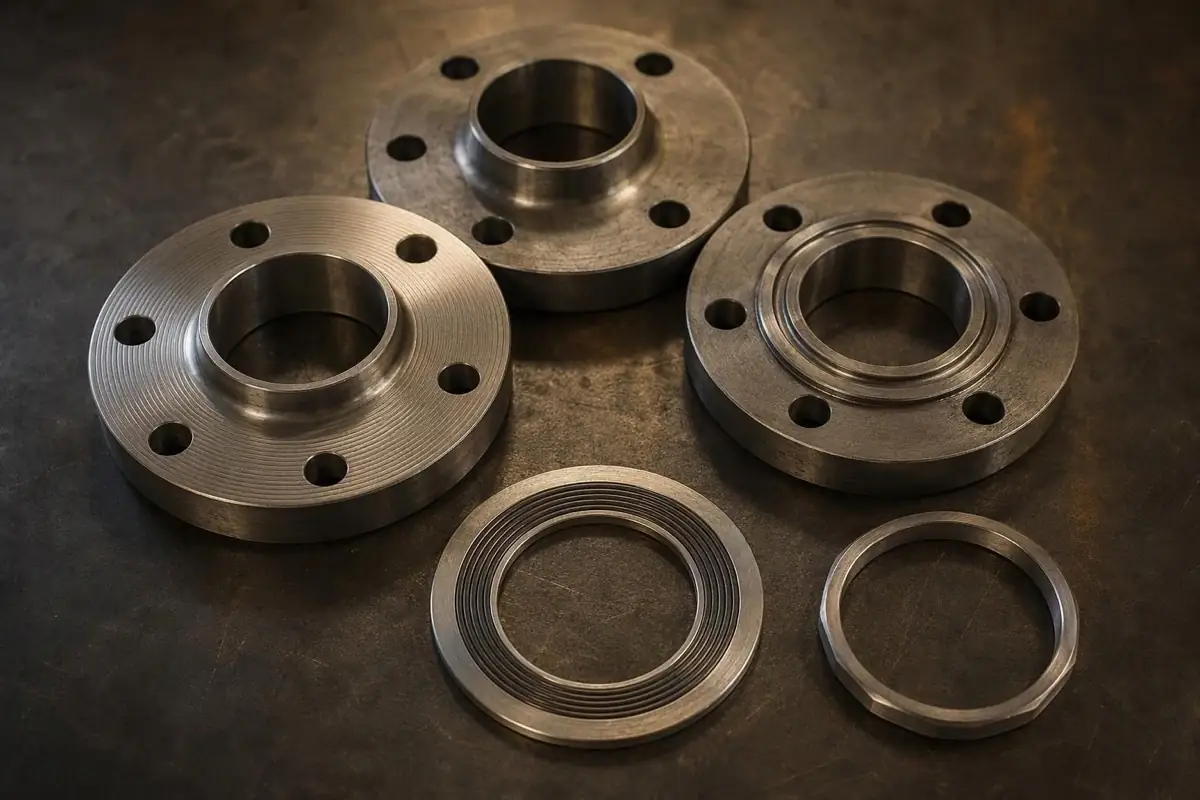
Flange Facings and Gasket Selection: RF, FF, RTJ Guide
The flange facing determines which gasket can be used. We put RF, FF, RTJ, tongue-and-groove and male-and-female facings; flat, spiral wound and ring joint gaskets; surface finish values; and the most common field mismatches into one table.
🔩 Products: Ring joint gaskets · Flanges · Dimensions: Flange Dimensions tool →
Short Answer
The flange facing is the shape of the sealing area where the gasket sits, and it determines which gasket type can be used. The most common facing is RF (raised face), used with flat gaskets and spiral wound gaskets. FF (flat face) usually mates with cast iron and low-pressure equipment flanges and needs a full-face gasket. RTJ (ring type joint) is a groove machined into the face and works only with a metal ring gasket; it is preferred at high pressure and temperature and in oil and gas lines. The rule is simple: flange facing, gasket type and mating flange are chosen together. If one changes, the other two are checked.
Facing Types
| Facing | Description | Suitable gasket | Typical use |
|---|---|---|---|
| RF (raised face) | Gasket surface raised inside the bolt circle | Non-metallic flat gasket, spiral wound, kammprofile | The great majority of process lines |
| FF (flat face) | Gasket surface flush with the whole flange face | Full-face flat gasket | Cast iron valve and pump flanges, low pressure |
| RTJ (ring type joint) | Trapezoidal groove machined into the face | Metal ring gasket (R, RX, BX; ASME B16.20) | High pressure and temperature, oil and gas |
| Tongue & groove | Tongue on one flange, groove on the other | Flat gasket confined in the groove | Services where gasket blow-out is unacceptable |
| Male & female | Spigot on one flange, recess on the other | Flat gasket seated in the recess | Heat exchangers and special equipment connections |
ASME B16.5 defines the facings under these names. In Europe, EN 1092-1 calls the flat face Type A and the raised face Type B; tongue and groove, spigot and recess and O-ring facings also appear in the same standard under separate type letters.
Raised face height: in ASME B16.5 it is about 1.6 mm (1/16 in) for Class 150 and 300 flanges and about 6.4 mm (1/4 in) for Class 400 and above. A practical note: in tables and catalogues, the flange thickness for Class 150/300 usually includes the 1.6 mm raised face, while for Class 400 and above the 6.4 mm is mostly shown in addition to the thickness. Check which value is used when calculating bolt length and spacers.
Surface Finish: Where the Gasket Grips
A gasket seals by embedding into the micro-roughness of the flange face. If the face is too smooth, a flat gasket slides; if it is too rough, a leak path remains.
- RF face (ASME B16.5): concentric or spiral serrated finish; average roughness 3.2–6.3 µm Ra (125–250 µin). This is the standard face for flat and spiral wound gaskets.
- RTJ groove: roughness on the groove side walls must not exceed 1.6 µm Ra (63 µin). Because the ring gasket seats with line contact on the groove side walls, scratches and dents are direct leak paths.
Protect the flange face during handling and installation. A radial scratch across a serrated face opens a channel the gasket cannot seal.
Gasket Types
- Non-metallic flat gasket: Cut from fibre, graphite or PTFE-based sheet. Dimensions are given in ASME B16.21 for ASME flanges and in EN 1514-1 for PN flanges. Used at low and medium pressure on RF and FF faces.
- Spiral wound gasket: A V-section metal strip wound together with a filler (graphite, PTFE, etc.). An outer centring ring positions the gasket between the bolts. Dimensions for ASME flanges are in ASME B16.20. The standard requires an inner ring for certain size and class combinations and with certain fillers. It is the most common gasket for RF flanges at high pressure and temperature.
- Ring joint gasket: A solid metal ring. The R series (oval and octagonal section) and the RX and BX types are all defined in ASME B16.20; BX is used with API 6A 6BX flanges. The ring is chosen from a softer material than the flange, so that the ring, not the groove, deforms on tightening. Details are on our ring gasket product page: type R, type RX, type BX.
Facing × Gasket Compatibility Table
The table below is a matching summary we compiled from the definitions in the standards. When checking a purchase list, you can read each flange–gasket pair against it.
| Flange facing | Flat gasket (narrow, RF size) | Full-face flat gasket | Spiral wound | Ring joint (R / RX) |
|---|---|---|---|---|
| RF | ✓ Standard | ✗ Unsupported outside the raised face | ✓ Standard | ✗ No groove |
| FF | Possible, but full face is preferred | ✓ Standard | ✗ Usually not suitable | ✗ No groove |
| RTJ | ✗ | ✗ | ✗ | ✓ Only option; ring number must match the groove |
| Tongue & groove / male & female | ✓ Cut to the recess | ✗ | Only special types made for this geometry | ✗ |
✓ suitable · ✗ not suitable. Final selection is made with the service conditions and the gasket manufacturer's data.
The Most Common Mistakes in the Field
- Bolting an RF steel flange to an FF cast iron flange. As the bolts are tightened, the raised face bends the cast iron flange at its edge and can crack it. The correct solution is to use a flat face flange on the steel side as well, with a full-face gasket.
- Putting a spiral wound gasket on an RTJ flange. The RTJ groove gives a spiral gasket no seating surface. Only a ring gasket with the same number as the groove is used.
- Not stating the ring number. For RTJ orders, flange size and class alone are not enough. The ring number (e.g. R-xx) must match the flange groove. An RX ring seats in a standard R groove; BX is used only with API 6A flanges that have BX grooves.
- Reusing gaskets. Ring and spiral wound gaskets deform permanently on first tightening. A dismantled joint gets a new gasket.
- Not checking the gasket material against the fluid. The winding strip and filler of a spiral gasket, and the material of a ring gasket (soft iron, low carbon steel, 304, 316, etc.), are chosen for the fluid and temperature.
Which One to Choose?
- General process line, Class 150–600: RF facing + spiral wound or flat gasket.
- Connection to cast iron equipment: FF facing + full-face gasket.
- High pressure and temperature, shock or cyclic loading: RTJ facing + R/RX ring gasket. API 6A and BX for wellhead equipment.
- If gasket blow-out is unacceptable: tongue and groove or male and female.
Check the pressure class for material and temperature with the Pressure Class tool and the flange outside dimensions with the Flange Dimensions tool. For metric bolts, the Bolt Torque table helps with tightening torque. The bolt load the gasket needs, however, must be calculated from the gasket manufacturer's data.
What to Write in the Specification
For the flange: type (WN, SO, blind…), NPS/DN, class or PN, facing (RF, FF, RTJ), the ring number for RTJ, surface finish (e.g. serrated 3.2–6.3 µm Ra), material (e.g. A105, A182 F316L), standard (ASME B16.5 / EN 1092-1).
For the gasket: type, standard (ASME B16.20 / B16.21 / EN 1514), size and class, materials (spiral strip and filler, inner and outer rings; ring gasket material), ring gasket number.
Documents: EN 10204 3.1; third-party inspection by SGS, Bureau Veritas or TÜV if required.
Frequently Asked Questions
Can an RF flange be bolted to an FF flange?
For steel-to-steel joints it is possible but not recommended. Bolting an RF steel flange to a cast iron FF flange carries a risk of cracking. In that case use a flat face flange on the steel side too, with a full-face gasket.
Can a spiral wound gasket be used on an RTJ flange?
No. On an RTJ facing, the gasket seating surface is a groove, and it seals only with a metal ring gasket of the matching number.
Is the raised face height included in the flange thickness?
The raised face is about 1.6 mm for Class 150 and 300 and about 6.4 mm for Class 400 and above. In tables and catalogues it is usually included in the thickness for Class 150/300 and mostly shown in addition for higher classes. Check the note of the table you use before calculating bolt length.
Can an RX ring gasket be fitted in an R groove?
Yes. RX is a pressure-energized type that seats in a standard R groove. BX has a different groove geometry and is used only with flanges that have BX grooves.
Sourcing from Aktif Çelik
We supply ring joint gaskets in R, RX and BX types, and flanges with RF, FF and RTJ facings in A105, A350 LF2, A182 alloy and stainless grades, with an EN 10204 3.1 inspection certificate. If you send the flange and gasket items together, we prepare the quote after checking facing, gasket type and ring number compatibility. Quotes are sent within 24 hours; lead time and minimum quantity vary by product and are stated in the quote.
🔗 See also: Flange Types Guide · ASME B16.5 Guide · Quality & Certificates
Detailed Technical Info & Quotation
Contact our expert team for detailed technical documents, application recommendations, and custom dimension quotes on this topic.