
Anchor Flanges / AF-G
Guide Anchor Flange
Directed anchor flange providing controlled linear movement and guiding support.
Technical Specifications
Key Features
- Controlled linear movement
- Axial load support
- Radial restraint
- Sliding surfaces
- Lubrication channels
- Wear plates
Applications
- Thermal expansion lines
- Long pipe runs
- Heat exchanger connections
- Steam lines
- Chemical plants
- Refineries
Design Features
- Sliding bearing surfaces
- Wear pad plates
- Lubrication system
- Movement sensor mount
- Sealing gasket
Dimension Table
| Size | Outside Diameter (mm) | Thickness (mm) | Bolt Circle (mm) | No. of Bolts | Guide Length (mm) | Clearance (mm) |
|---|---|---|---|---|---|---|
| 4" | 235 | 20 | 152.5 | 8 | 200 | 5 |
| 6" | 285 | 23 | 190.5 | 8 | 250 | 5 |
| 8" | 350 | 26 | 241.5 | 8 | 300 | 6 |
| 12" | 490 | 33 | 355.5 | 12 | 400 | 6 |
| 16" | 605 | 39 | 457 | 16 | 500 | 8 |
| 24" | 760 | 49 | 641 | 20 | 600 | 8 |
Technical Notes
- 01Sliding surfaces must be lubricated regularly.
- 02Movement range must be limited.
- 03Wear plates require periodic inspection.
- 04Thermal expansion must be calculated.
What is an anchor flange?
An anchor flange is a heavy forged flange welded into a pipeline and encased in a concrete anchor (thrust) block. It is not a bolted joint: its job is to fix the pipe axially and transfer thrust loads from thermal expansion and internal pressure into the structure. Produced from 2" to 60" to ASME/AWWA practice or fully custom design.
Where and how anchor flanges are used
Anchor flanges are placed wherever the pipeline needs a fixed point: pump and compressor station boundaries, both banks of river and road crossings, steep slopes, aboveground-to-buried transitions and line terminations. The flange is butt-welded into the pipe on both sides and then embedded in a concrete block; expansion forces spread into the concrete through its large outside diameter. Unlike a standard flange it has no gasket face and no bolt holes — it is purely a load-transfer component. Each unit is custom-engineered from the pipe diameter, wall thickness, operating pressure and axial load calculation. Materials: forged carbon steel A105, A694 F42–F70 to match line pipe strength, A350 LF2 for low temperature. Delivered with NDT (UT/MT) and 3.1 certificates.
Frequently Asked Questions
What is the difference between an anchor flange and a standard flange?+
A standard flange is a bolted, demountable joint; an anchor flange has no gasket face or bolt holes — it is a load-transfer component that fixes the pipe into concrete.
What loads does an anchor flange carry?+
Axial thrust loads from thermal expansion/contraction and internal pressure; it takes them from the welded pipe and transfers them into the concrete anchor block.
Where are anchor flanges installed?+
At pump/compressor station boundaries, on both banks of river and road crossings, on steep slopes, at aboveground-to-buried transitions and at line terminations.
Which materials are anchor flanges made from?+
Forged carbon steel A105, A694 F42–F70 to match line-pipe strength, or A350 LF2 for low-temperature service; dimensions are engineered per project and verified with NDT + 3.1 certificates.
Related Blog Posts
Technical articles, guides and industry analyses
Flange Types Guide: The 7 Main Flange Types and How to Choose
We explain weld neck, slip-on, blind, socket weld, threaded, lap joint and orifice flanges — their construction, facing types (RF/FF/RTJ), pressure classes and selection criteria.
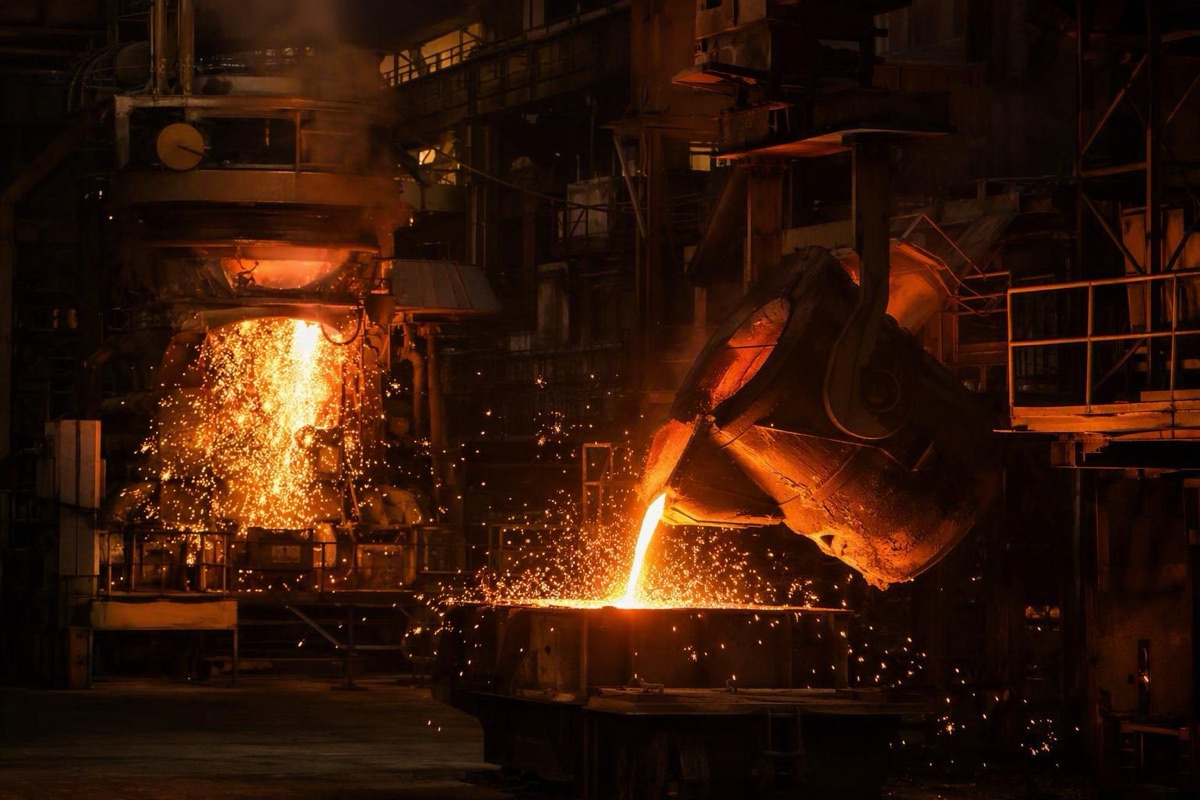
EAF vs BOF: Electric Arc Furnace vs Basic Oxygen Furnace
We compare the electric arc furnace (EAF) and the basic oxygen furnace (BOF) by energy source, charge material, scale, carbon footprint and typical products.