Pig Iron / SP
Nodular Pig Iron
Low-impurity pig iron specially produced for ductile (spheroidal graphite) iron production.
Technical Specifications
Key Features
- Very low phosphorus (0.03% max)
- Very low sulfur (0.02% max)
- Low manganese (0.15% max)
- Clean metallurgical structure
- Ideal base material for nodularization
Applications
- Ductile (spheroidal graphite) iron production
- Automotive suspension parts
- Crankshafts and connecting rods
- Wind turbine components
- High strength pipe production
Dimension Table
| Element | Min. | Max. | Typical |
|---|---|---|---|
| C | 3.5 | 4.0 | 3.8 |
| Si | 0.5 | 1.0 | 0.7 |
| Mn | 0 | 0.15 | 0.10 |
| P | 0 | 0.03 | 0.02 |
| S | 0 | 0.02 | 0.01 |
Technical Notes
- 01P and S levels are critical for ductile iron quality.
- 02Low Mn content improves nodularization efficiency.
- 03Scrap ratio should be kept as low as possible.
- 04Temperature control before nodularization with FeSiMg is important.
Other Types
What is pig iron?
Pig iron is high-carbon crude iron (about 3.5–4.5% C) produced by reducing iron ore with coke in a blast furnace. It is brittle and not used directly; it is an intermediate product that is refined into steel (by lowering the carbon) or remelted into cast iron. Main types are basic (steelmaking) pig iron, foundry (hematite) pig iron and nodular pig iron for ductile-iron casting.
How pig iron is made and where it is used
In a blast furnace, iron ore, coke and limestone are charged in layers; the molten iron collects at the hearth and is cast as pig iron. Its high carbon and silicon content make it hard but brittle. In steelmaking (BOF/EAF) it is melted with scrap as the primary raw material for steel; in foundries it serves as a charge material to adjust chemistry for grey and ductile iron castings. Controlling the composition (C, Si, Mn, S, P) determines the quality of the final product.
Frequently Asked Questions
What is the difference between pig iron and cast iron?+
Pig iron is the raw intermediate from the blast furnace; cast iron is the finished product made by remelting pig iron and pouring it into moulds (grey, ductile, etc.).
What is the carbon content of pig iron?+
About 3.5–4.5% carbon, plus silicon, manganese, sulphur and phosphorus. This high carbon makes it brittle.
What is pig iron used for?+
As the primary raw material for steelmaking (together with scrap) and as a charge material in foundries for grey and ductile iron castings.
What is nodular pig iron?+
A special low-sulphur, controlled-composition pig iron suitable for producing ductile (spheroidal-graphite) iron castings.
Related Blog Posts
Technical articles, guides and industry analyses
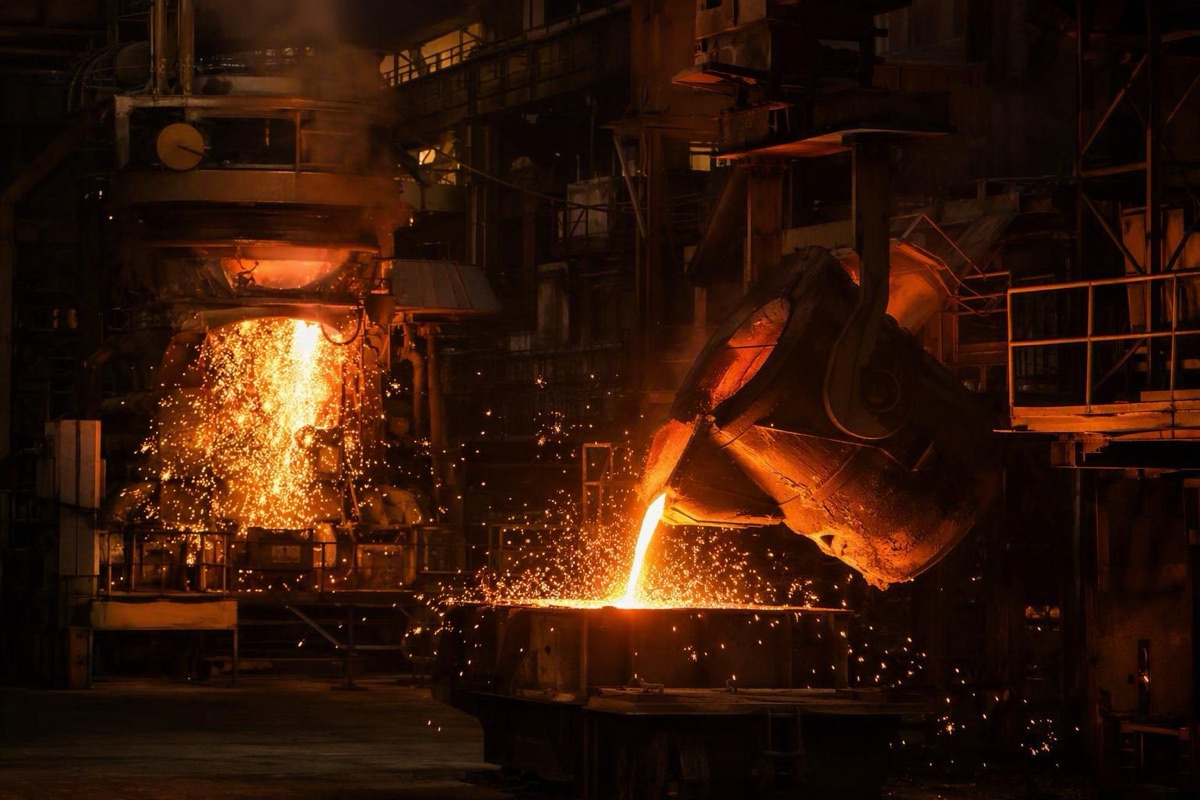
EAF vs BOF: Electric Arc Furnace vs Basic Oxygen Furnace
We compare the electric arc furnace (EAF) and the basic oxygen furnace (BOF) by energy source, charge material, scale, carbon footprint and typical products.
Cast Iron vs Cast Steel: Differences, How to Tell Them Apart, Which to Choose
The only thing separating cast iron from cast steel is carbon content — and that single difference changes toughness, weldability and cost completely. Differences, shop-floor identification tests and a selection guide.