Steel Pig Iron
High carbon pig iron used as charge material in steel production.
Technical Specifications
Key Features
- High carbon content (3.8-4.2% C)
- Low silicon ratio
- Low phosphorus and sulfur
- Homogeneous chemical composition
- Stable melting behavior
Applications
- Electric arc furnace (EAF) charge
- Basic oxygen furnace (BOF) charge
- Induction furnace charge
- Carbon source in steel production
Dimension Table
| Element | Min. | Max. | Typical (indicative) |
|---|---|---|---|
| C | 3.8 | 4.2 | 4.0 |
| Si | 0.5 | 1.0 | 0.8 |
| Mn | 0.3 | 0.5 | 0.4 |
| P | 0 | 0.05 | 0.04 |
| S | 0 | 0.03 | 0.02 |
Technical Notes
- 01Low Si content is ideal for steel production.
- 02Phosphorus and sulfur ratios are tightly controlled.
- 03Ingot weight is typically between 5-20 kg.
- 04Store in dry and ventilated environment.
Other Types
Steel Pig Iron: chemical analysis and selection notes
Steel Pig Iron is one of the pig iron types in our range; main uses: electric arc furnace (EAF) charge; basic oxygen furnace (BOF) charge. It is supplied as ingot / block (packaging: bulk / pallet). In an electric arc furnace or converter, pig iron is a clean source of iron units: carbon at 3.8–4.2% supplies chemical energy when oxygen is blown, and because the iron comes from ore rather than scrap it carries hardly any copper, tin, nickel or chromium, so it dilutes the residual elements brought in by scrap. Silicon is kept to 0.5–1.0% so that the slag volume stays small.
The analysis table on this page gives C 3.8–4.2% (typ. 4.0), Si 0.5–1.0% (typ. 0.8), Mn 0.3–0.5% (typ. 0.4), P ≤ 0.05% (typ. 0.04), S ≤ 0.03% (typ. 0.02).
Compared with the other types in this group: Hematite Pig Iron: C 3.5–4.0% (here 3.8–4.2%), Si 1.5–2.5% (here 0.5–1.0%), Mn 0.5–1.0% (here 0.3–0.5%); main use: grey (lamellar graphite) cast iron production. Nodular Pig Iron: C 3.5–4.0% (here 3.8–4.2%), Mn ≤ 0.15% (here 0.3–0.5%), P ≤ 0.03% (here ≤ 0.05%); main use: ductile (spheroidal graphite) iron production.
To request a quotation for Steel Pig Iron, state the limits you need for C, Si, Mn, P and S (the table values, such as P ≤ 0.05%, are a reference), the piece form (ingot / block), the packaging and the quantity. For arc-furnace practice, also state any limits on residual elements such as copper or tin. Third-party inspection, including sampling and analysis, by bodies such as SGS, Bureau Veritas or TÜV is arranged on request. Whether this type can be supplied from stock, the minimum quantity and the lead time are stated in the quotation, which is sent within 24 hours.
What is pig iron?
Pig iron is high-carbon crude iron (about 3.5–4.5% C) produced by reducing iron ore with coke in a blast furnace.
Pig Iron: guide and FAQRelated Blog Posts
Technical articles, guides and industry analyses
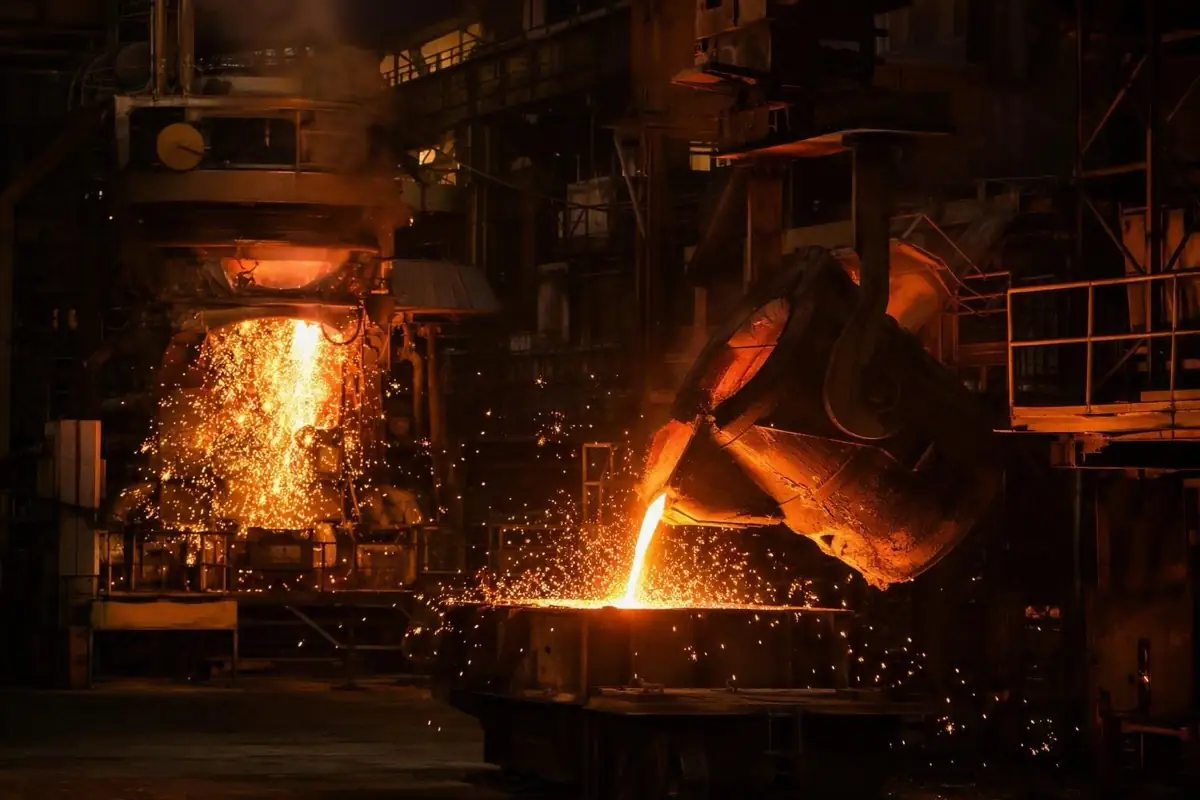
EAF vs BOF: Electric Arc Furnace vs Basic Oxygen Furnace
We compare the electric arc furnace (EAF) and the basic oxygen furnace (BOF) by energy source, charge material, scale, carbon footprint and typical products.
Cast Iron vs Cast Steel: Differences, How to Tell Them Apart, Which to Choose
The only thing separating cast iron from cast steel is carbon content — and that single difference changes toughness, weldability and cost completely. Differences, shop-floor identification tests and a selection guide.