Lead-Free Free-Cutting Steels
Lead-free free-cutting steels are grades developed for environmentally friendly production requirements. They replace leaded alternatives in RoHS-compliant applications.
Technical Specifications
Key Features
- Good machinability (lead-free formulation)
- RoHS and REACH compliant
- Clean chip formation
- Acceptable tool life
- Good surface finish quality
- Suitable for high-volume production
- Available in round, hexagon, and square profiles
- Environmentally friendly production processes
Applications
- RoHS-compliant electronic component parts
- Automotive industry fasteners
- CNC machined general machine parts
- Bolt, nut, and screw production
- Pin and bushing manufacturing
- Hydraulic and pneumatic fittings
- Food machinery parts
- Medical device components
Dimension Table
| Form | Size Range (mm) | Tolerance | Standard Length |
|---|---|---|---|
| Round | 2 - 120 mm | h9, h10, h11 | 3 m (min 2.5 m, max 6 m) |
| Hexagon | 5 - 80 mm | h9, h10, h11 | 3 m (min 2.5 m, max 6 m) |
| Square | 5 - 70 mm | h9, h10, h11 | 3 m (min 2.5 m, max 6 m) |
Technical Notes
- 0111SMn30 (1.0715) is the most commonly used lead-free free-cutting steel grade.
- 02Manganese sulfide (MnS) inclusions serve the chip-breaking function.
- 03Slightly lower cutting speeds should be applied compared to leaded grades.
- 04EN ISO 683-4 defines hot-rolled production requirements.
- 05EN 10277 specifies cold-drawn mechanical properties.
- 0644SMn28 (1.0762) is suitable for applications requiring higher strength.
- 07Lead-free grades are mandatory in food and medical industry sectors.
Other Types
Lead-Free Free-Cutting Steels: grades, standards and selection notes
This page covers Lead-Free Free-Cutting Steels, part of our Free-Cutting Steels range. Sizes in the dimension table: round 2–120 mm; hexagon 5–80 mm; square 5–70 mm. Tolerance classes: h9, h10, h11. Grades named for this type: 11SMn30 (1.0715), 11SMn37 (1.0736), 44SMn28 (1.0762). It is supplied to EN ISO 683-4 (free-cutting steels) and EN 10277 (technical delivery conditions for bright steel products).
Reference grades with the chemical composition (wt %) and strength values of the standard: 11SMn30 (W.-Nr. 1.0715 · AISI/SAE 1213 · JIS SUM22 (SUM22L)): C ≤ 0.14, Mn 0.90–1.30, S 0.27–0.33, Rm 510–810 MPa, Rp0.2 ≥ 440 MPa (+C, 5 ≤ d ≤ 10 mm). The grade datasheets linked below carry the full tables and equivalents. The table lists round 2–120 mm, hexagon 5–80 mm and square 5–70 mm, all in tolerance classes h9, h10, h11.
How the other types differ, according to their data: Leaded Free-Cutting Steels: grades 11SMnPb30 (1.0718), 11SMnPb37 (1.0737), 36SMnPb14 (1.0765), 38SMnPb28 (1.0761), 44SMnPb28 (1.0763); 11SMnPb30: Pb 0.20–0.35 (11SMn30: Pb —). Leaded grades allow higher cutting speeds and shorter chips on automatic lathes; lead-free grades are specified where the customer or the application restricts lead.
To request a quotation for Lead-Free Free-Cutting Steels, state the grade (for example 11SMn30), the cross-section (round, hexagon and square), size, tolerance class (h9, h10, h11), the standard (EN ISO 683-4), length and quantity. Material is supplied with an EN 10204 3.1 inspection certificate; third-party inspection by bodies such as SGS, Bureau Veritas or TÜV is arranged on request. Whether the size can be supplied from stock, the minimum quantity and the lead time are stated in the quotation, which is sent within 24 hours.
Grade datasheets
Chemistry, mechanical properties and equivalents of the steel grades used for this product:
What is free-cutting steel?
Free-cutting (free-machining) steel has deliberately raised sulphur (0.10–0.35% S) for high-speed machining.
Free-Cutting Steels: guide and FAQRelated Blog Posts
Technical articles, guides and industry analyses
Free-Cutting Steel Grades: Choosing from 11SMn30 to 44SMn28
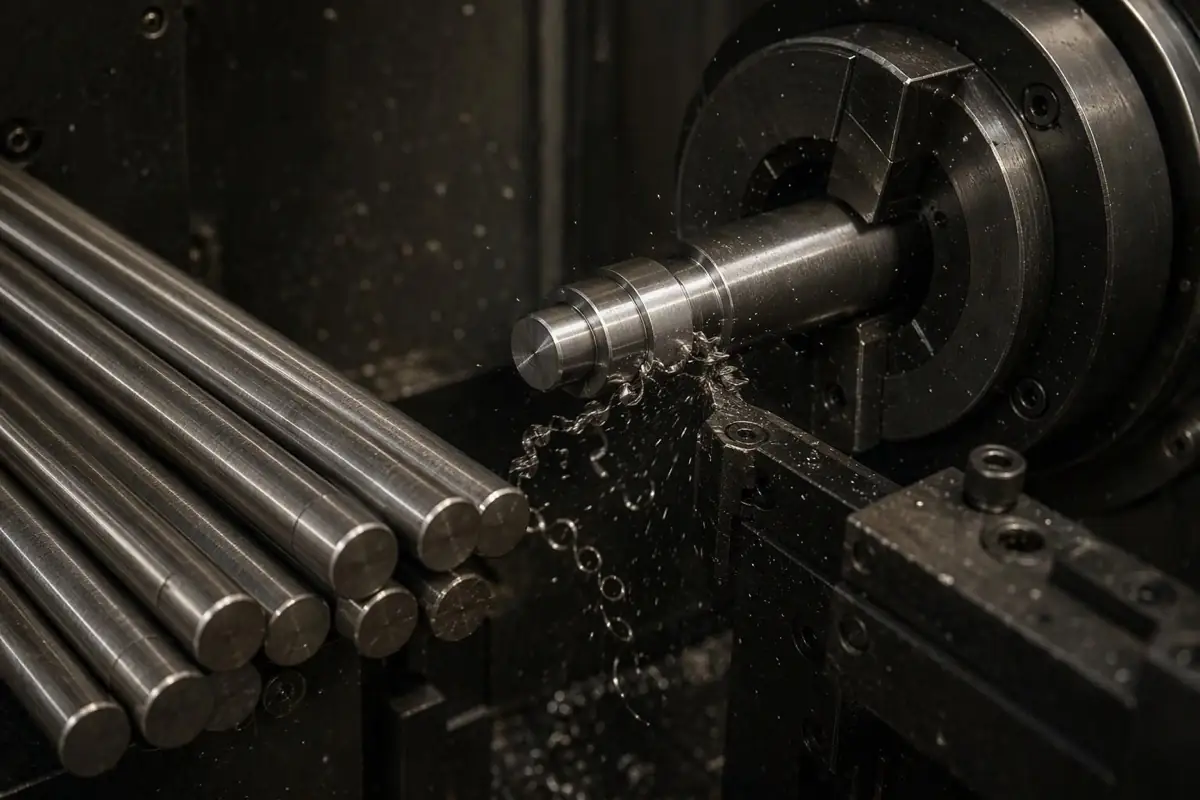
Free-cutting steel is more than 11SMn30 and 11SMnPb30. EN ISO 683-4 (formerly EN 10087) splits these steels into three groups: not intended for heat treatment, suitable for case hardening and suitable for quenching and tempering. Chemistry table, how machinability works and which grade suits which part.
Is Steel Magnetic? Which Steels Are Not Magnetic?
The vast majority of steels are magnetic — but not all. What decides it is not the alloy but the crystal structure: ferrite/martensite attracts, austenite doesn't. Why 304/316 stainless doesn't stick, and where the magnet test reaches its limits.