
Iron Casting / INOC
Inoculants
Ca, Ba and Sr based inoculants that promote graphite nucleation in cast iron production.
Technical Specifications
Key Features
- Ca-based: Si 70-76%, Ca 1-2% - general purpose inoculation
- Ba-based: Si 70-76%, Ba 2-4% - long-lasting, fading resistant
- Sr-based: Si 70-76%, Sr 0.5-1% - for thin-section parts
- Chill (white solidification) prevention
- Ensures homogeneous graphite distribution
- Grain sizes suitable for different application methods
Applications
- Ductile iron inoculation
- Grey iron inoculation
- Thin-section castings
- Automotive cast parts
- Pipe and valve bodies
- Hydraulic components
Dimension Table
| Element | Min (%) | Max (%) | Typical (%) |
|---|---|---|---|
| Si | 70 | 76 | 73 |
| Ca | 1.0 | 2.0 | 1.5 (Ca-based) |
| Ba | 2.0 | 4.0 | 3.0 (Ba-based) |
| Sr | 0.5 | 1.0 | 0.7 (Sr-based) |
| Al | 0.5 | 1.5 | 1.0 |
| Fe | - | - | Balance |
Technical Notes
- 01Ba-based inoculants have longer fading time.
- 02Sr-based inoculants effectively prevent chill in thin sections.
- 03Inoculation amount is typically between 0.1-0.5%.
- 040.2-0.7mm grain size is used for in-mold inoculation.
- 051-3mm or 3-8mm preferred for ladle inoculation.
Other Types
What are iron casting materials?
Iron casting materials are the metallurgical additives foundries use to control the structure of liquid iron. There are two main groups: inoculants (FeSi75-based alloys containing Ca, Ba or Sr) trigger graphite nucleation, while nodularizers (FeSiMg) convert flake graphite to spheroidal graphite, enabling ductile iron (GJS) production.
How inoculation and Mg treatment work
Inoculation seeds the melt with graphite nucleation sites just before casting: it prevents carbide (white iron/chill) formation, gives a uniform graphite distribution and improves machinability. Typical addition is 0.1–0.4%; Ca-based inoculants are general purpose, Ba-bearing grades hold their effect longer (fading resistance) for heavy, slow-cooling castings, and Sr-bearing grades excel in thin-wall grey iron with low slag. Nodularization is the heart of ductile iron production: an FeSiMg alloy with 3–10% Mg (typical addition 1.0–1.5%) binds the sulphur and oxygen in the melt and forces graphite to solidify as spheres — yielding far higher tensile strength and ductility than grey iron. Because Mg treatment inevitably reduces nucleus count, inoculation always follows nodularization. These are the standard consumables of automotive, pipe and machine-body foundries.
Frequently Asked Questions
What does an inoculant do?+
It seeds liquid iron with graphite nucleation sites: prevents chill (carbide) formation, homogenizes graphite distribution and improves mechanical properties and machinability. Typical addition is 0.1–0.4%.
Ca vs Ba vs Sr inoculants — what is the difference?+
Ca-based is general purpose; Ba-bearing keeps its effect longer (heavy, slow-cooling castings); Sr-bearing gives strong chill prevention in thin sections with low slag formation.
How does an FeSiMg nodularizer work?+
Its magnesium (typically 3–10%) binds the sulphur and oxygen in the melt, so graphite solidifies as spheres instead of flakes. The result is ductile iron: high strength plus ductility.
Why is inoculation needed after Mg treatment?+
Mg treatment lowers the nucleation potential; post-treatment (or in-stream) inoculation raises the nodule count and eliminates carbide risk.
Related Blog Posts
Technical articles, guides and industry analyses
Cast Iron vs Cast Steel: Differences, How to Tell Them Apart, Which to Choose
The only thing separating cast iron from cast steel is carbon content — and that single difference changes toughness, weldability and cost completely. Differences, shop-floor identification tests and a selection guide.
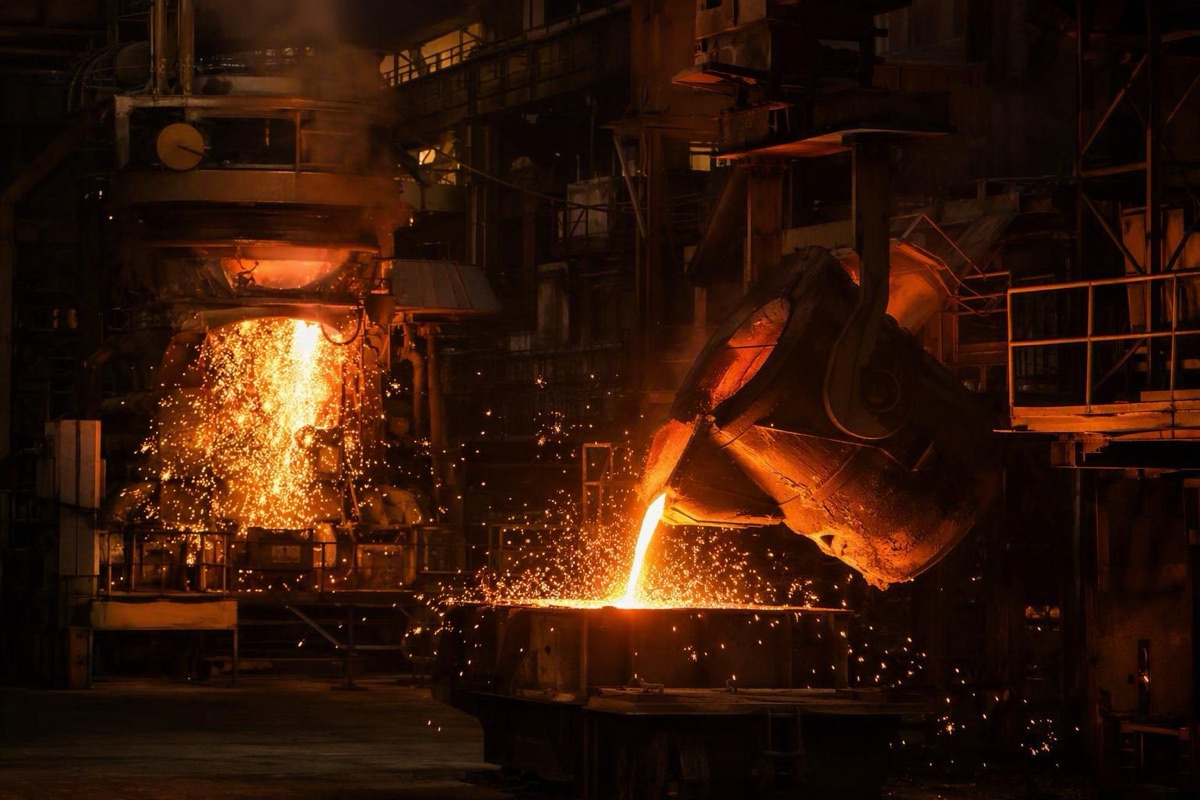
EAF vs BOF: Electric Arc Furnace vs Basic Oxygen Furnace
We compare the electric arc furnace (EAF) and the basic oxygen furnace (BOF) by energy source, charge material, scale, carbon footprint and typical products.